Monday, November 3, 2014

Colossians Remixed

The book is now 10 years old, but I finally got around to the theological and ethical masterpiece that has been recommended to me by many different people, "Colossians Remixed: Subverting the Empire."  The book is a work of historical fiction, the story of a wealthy Roman citizen who is considering giving her life to Christ, which causes her to grapple with the differences between the Caesar's Kingdom (the Roman Empire, which has secured a good life for her) and the Kingdom of Jesus.  While comparing the differences of the two kingdoms, the book works through Paul's letter to the church at Colossi.

Here are some of the notes I took from the book.  Enjoy.

Pg. 31, Empires are built on systemic centralizations of power and secured by structures of socioeconomic and military control.  They are religiously legitimated by powerful myths that are rooted in foundational assumptions, and they are sustained by a proliferation of imperial images that captivate the imagination of the population.
Pg. 33, Another way to look at this is to say that in a world of imperial control, in a world that is suffused with the rhetoric, symbolism and images of empire, we need to have appeal to a power, a sovereignty greater than the empire, if we are to have any hope. 
Richard Berger anticipated the commodification of belief in a radically pluralistic society in The Sacred Canopy: Elements of a Sociological Theory of Religion.  He argued that once culture recognizes the constructed character of reality, religious traditions can no longer be imposed (so say nothing of “assumed”); they must be marketed.  Religion “must be ‘sold’ to a clientele that is no longer constrained to ‘buy.’  The pluralist situation is, above all, a market situation.  In it, the religious institutions become marketing agencies and the religious traditions become consumer commodities.” 
So captivated by the consumerist imagination of the empire, and so immersed in the empire’s self-justifying mythology and rhetoric, we find ourselves unable to fathom the depths of the crisis in which we now live.
Pg. 51, an imaginary conversation between a Christian and a wealthy Roman citizen considering following Christ
“Why, if someone unsympathetic heard you they might think you were suggesting that Caesar isn’t our lord and savior.  They might think you didn’t appreciate the peace and prosperity that Rome brought.  Don’t you see the kind of trouble you could get into with this way of thinking?”
“But that’s the point,” she said, “I don’t believe that Caesar is our savior.  I don’t believe that he has brought peace and prosperity.  And I don’t believe that Caesar is our savior.  I don’t believe that he has brought peace and prosperity.  And I don’t worship him or any of the other gods, any more.”
“And has Caesar given them peace?  No. Only death and destruction, demolishing their cities, enslaving the inhabitants, demanding taxes that drive the small landowners to slavery and revolt…. This is peace by the blood of the sword… This peace is good for you.  And it has been good for me, too.  But it isn’t good for everyone.  This peace divides – it makes the peasants hopeless and the wealthy even wealthier. 
But the peace of Jesus is different.  The peace of Jesus isn’t imposed by violence.”
“You see, what Lydia was telling me was nothing less than treasonous, a threat to the empire.
I was disturbed.  Lydia had offered a challenge to my faith in the empire.  I knew that her story and mine couldn’t both be true.  Either Caesar had brought forgiveness of our sings, fruitfulness and peace through the great victories he had wrought, or Jesus had brought forgiveness of our sins, fruitfulness and peace through his paradoxical victory on a Roman cross.  But this seemed impossible, unimaginable!
It was also clear that Lydia’s story of Jesus could not be happily accommodated by the imperial regime.  Devotion to Jesus was not like the devotion to Isis or Apollo.  These gods and their cults were no threat to the empire.  Actually, such private devotion, it was believed, made one a better citizen and enhanced one’s public duty to the empire.  Jesus, however, created a problem.  His lordship clearly precluded Caesar’s, and the guarded privacy of my conversation with Lydia notwithstanding, it was clear that following Jesus could not be a private matter but would have to be a public faith, transforming public life.”
Pg. 58, In chapter one we stated that empires are 1) built on systemic centralization of power, 2) secured by structures of socioeconomic and military control, 3) religiously legitimized by powerful myths and 4) sustained by a proliferation of imperial images that captive the imagination of the population.
Thus, it is no surprise that for every dollar that is sent in foreign aid to Africa, four are returned in the form of debt-servicing.
Pg. 67, When Israel enters the Promised Land, it faces its greatest challenge not to become like the empire it left behind.  As the story unfolds, it becomes clear that such an empire is very seductive.
It is the prophets who most tellingly deconstruct the imperial distortions of Israel.  The covenant people do not care for aliens, widows and orphans, or the weak and injured (Is. 1:23; 10:2; Jer. 5:27-29; 7:5-7; 22:3-6; Ezek 22:7, 34:1-6, Zech 7:8-14; Mal 3:5).  Failing to practice mercy and justice (Is 5:7; Jer 22:13-17; Hos 12:7-8; Amos 5:7; 6:12; Mic 6:1-12), Israel grinds down the poor and needy (Is 3:14-15; 10:2; 32:7; 58:3, Jer 2:34; Ezek 22:29; Amos 2:6-7; 4:1; 5:11; 8:4-8; cf. Job 24:9-14; Ps 37:14; 109:16).  The people have been engaged in the consumptive practices of empire, filling their land with silver and gold, horses and chariots buying up neighbors’ fields until nothing is left but industrial farms-as-business that kills community (Is 2:7; 5:8).  Moreover, they consistently engage in business deals that exploit the poor (Amos 8:5-6).
Pg. 68, This is a call to be God’s people by bringing shalom and healing on places of brokenness and despair.  And what could be more broken and more in need of healing than the place of oppression, the heart of the empire?
Under the oppressive rule of Babylon and Assyria, the Israelites are still called to build a faithful community and to live subject to a different kind of rule and kingship, one where imperial might and power is used for feeding the hunger of the people and binding up their wounds.
Pg. 70, As Luke tells the story, almost everything Jesus did or said was an implicit challenge to the empire and its way of working in the world…. This is a kingdom where the ruler is enthroned on a cross – the Roman Empire’s instrument of torture – and in such an enthronement winds freedom and life for its people.
Pg. 74, As the parallel passage in Matthew shows, reconciliation is the fruit of this kingdom (Mt. 5:25-26).  This is an ethic in which the generosity of God overcomes the violence and economic exploitation of the empire.  And once they are so overcome and undermined, the empire begins to crumble. 
Pg. 75, Paul tells the Colossians that the gospel of Jesus bears a fruit in their lives that is fundamentally different from the fruit of the empire.  The fruit of this gospel is rooted not in military might and economic oppression but in the practice of justice and sacrificial faithfulness.  This is a gospel that bears fruit “in every good work” of forgiving generosity and therefore undermines the hoarding abundance touted by the empire.
Pg. 90, [On Colossians 1:15-20] So what does Paul do with these cultural myths?  He turns them on their head and replaces Zeus, Caesar, Rome and any other pretender to sovereignty with Christ.  Then he takes it a step further and replaces the body – whether it be the cosmos or the empire – with the church.
And the main use of “powers” is not in reference to spiritual beings but to what Walter Wink calls the “legimitations, sanctions, and permissions that undergird the everyday exercise of power.”
So it isn’t a stretch to say that in the Roman empire, “thrones, dominions, rulers and powers” referred to Rome – to its “ruler” Caesar, on the “throne” established by the gods, to his “dominion” over all the known world, established and maintained by the “power” and might of the empire… It would be impossible for his listeners to hear this list – thrones, dominions, rulers, powers and not have thought of imperial thrones, imperial rule, the emperor and his court, and imperial sanctions and legitimations.
That spiritual dimension has to do with whether these structures of our life are directed by an idolatrous spirit of empire or the Spirit of God in Christ, who created all of these structures of life and before whom they are subject.
You see, when the Christian community abandons discussion of oppressive social structures, there are consequences.  In the first instance, if the Christian voice is absent, then the discussion necessarily goes on without a Christian perspective.  It is not surprising that other worldviews and categories of analysis fill in the void.  And if Christians don’t like those worldviews – whether they be Marxist, anarchist, “green” or whatever – then they really have no right to complain.  After all, these same upset Christians have left the world of oppressive social structures for someone else to worry about.
A lack of attention to the temporal structures of oppression is devastating for the community that follows Jesus.  Berry describes a dualistic church in an imperial context:
“The church has, for the most part, stood silently by while a predatory economy has ravaged the world, destroyed its natural beauty, divided and plundered its human communities and households.  It has flown the flag and chanted the slogans of empire.  It has assumed with the economists that ‘economic forces’ automatically work for good and has assumed with the industrialists and militarists that technology determines history. It has assumed with almost everybody that ‘progress’ is good, that it is good to be modern and up with the times.  It has admired Caesar and comforted him in his depredations and defaults.  But in its de facto alliance with Caesar, Christianity connives directed with the murder of Creation.”
For Paul, rather than “flying the flag of empire,” the church is a community in refusal of the empire which bears the image of another Lord in its daily life.
A split-vision worldview that divides faith from life, church from culture, theology from economics, prayer from politics and worship from everyday work will always render Christian faith irrelevant to broad sociocultural forces.  And that is exactly what the empire wants – a robust, piously engaging private faith that will never transgress the public square.  Allow religion to shape private imagination, but leave the rest of life, the public and dominant imagination, to the empire.  Only as we break through this dualism can the poem (Colossians 1:15-20) be given be given enough space in our lives to liberate our imagination. 
Pg. 96, It is quite another thing to hold a faith that is seditions to the empire.  How do you go about confessing Christ as Lord when everything all around you – all the power structures, the images that dominate your daily life and even the very temporal rhythms of that life – declare the sovereignty, lordship, honor and glory of the empire and its emperor?
This was as vexing a problem for first-century Christians as it is for twenty-first century Christians.
Pg. 110, Again, the foundation of this kingdom is not in the self-righteous exclusion but in the inclusion of forgiveness… But if the rulers and authorities, regimes and empires that so oppress us are to be defeated, they must be defeated not by further violence but by sacrificial love.
“The cross was not the defeat of Christ at the hands of the powers; it was the defeat of the powers at the hands – yes, the bleeding hands – of Christ.” – NT Wright
Turning the empire on its head, the cross becomes the site of the victory march of the victim.
Pg. 114, Only the nonideological, embracing, forgiving and shalom-filled life of a dynamic Christian community formed by the story of Jesus will prove the gospel to be true and render the idolatrous alternatives fundamentally implausible.

Pg. 115, Empire loves to have a monopoly on truth.
Pg. 130, Remember, from a biblical perspective truth is not a correspondence between ideas and facts.  Truth is embodied in a person.
Pg. 138, And Jesus takes precisely the principalities and powers that placed him on the cross – the idols of militarism, nationalism, racism, technicism, economism – and on that very cross disarms, dethrones, conquers and makes public example of them.  In this power struggle, sacrificial love is victorious precisely by being poured out on a cross, a symbol of imperial violence and control.
Pg. 150, Everyone, we contend, lives out of a metanarrative, everyone meets their life in a grounding worldview that directs their praxis and serves to legitimate that praxis… Pg. 156 We don’t allow the empire to captivate our imagination and set the final term of our praxis in the world, because we can see a kingdom that is an alternative to the empire.
Pg. 155 (Col 3:17) Seeking that which is above is a matter not of becoming heavenly minded but of allowing the liberating rule of Christ to transform every dimension of your life.
Pg. 166 In his 1994 annual report, the president of Campbell’s Soup Company wrote “As I look forward to the future, I shiver with business excitement.  That’s because Campbell’s Soup Company is engaged in a global consumer crusade.  This is a crusade to capture both consumer taste and culinary practice.  There is nothing that Campbell’s would like better than to have more markets of people who will forget how to make soup for themselves and will become dependent on a can.  Or consider this moment of enlightened business ethics from David Glass, CEO and president of Wal-Mart, “Our priorities are that we want to dominate North America first, then South America, and then Asia and then Europe.”  Business development is couched in the language of domination.  This, we contend, is the abusive language of our time.  When “free trade” means corporate sovereignity, “fiscal responsibility” means that the poorest in our society have to put up with even less, “quality of life” means quantity of consumption and the “liberation” of Iraq means the expansion of the Pax Americana, then our language has been debased and deformed into a discourse of deceit that justifies violence…. Pg. 167, Rather, the real abusive language is in the often sanitized ways of talking and thinking that serve to make this culture of death appear normal and acceptable.  Indeed, when the church’s language, in all of its piety, serves to give an air of normality to an idolatrously constructed culture, thereby functioning as a polite cover-up for a comfortable life in the empire, then that language is also abusive. 
Pg. 168, The ethical crisis of Christianity at the turn of the millennium is that Christians, by and large accept the empire as normal.  Here is Wendall Berry’s prophetic appraisal of the church:
“Despite protests to the contrary, modern Christianity has become willy-nilly the religion of the state and economic status quo.  Because it has been so exclusively dedicated to incanting anemic souls into Heaven, it has been made the tool of much earthly villainy.  It has, for the most part, stood silently by while a predatory economy has ravaged the world, destroyed its natural beauty and health, divided and plundered its human communities and households.  It has flown the flag and chanted the slogans of empire.  It has assumed with the economists that “economic forces” automatically work for good and has assumed with the industrialists and militarists that technology determines history.  It has assumed with almost everybody that “progress is good… It has admired Caesar and comforted him in his depredations and faults.  But in its de facto alliance with Caesar, Christianity connives directly in the murder of Creation.”
Pg. 170, As long as we lack the courage to take a stand and remain unrooted in a narrative that would be subversive to the principalities and powers, the empire can remain secure. Kall Lasn puts it this way: “American culture is no longer created by the people… a free, authentic life is no longer possible in America ™ today.  We are being manipulated in the most insidious way.  Our emotions, personalities and core values are under siege from media and cultural forces too complex to decode.  A continuous product message has woven itself into the very fabric of our existence.  Most North Americans now live designer lives – sleep, eat, sit in a car, work, shop, watch TV, sleep again.  I doubt there’s more than a handful of free, spontaneous minutes anywhere in that cycle.  We ourselves have been branded.”
Lasn likens life in what he calls America ™ to a life in a cult in which “we have been recruited into roles and behavior patterns that we did not consciously choose… When a whole population dreams the same dream, empire is triumphant… In the face of the ensnaring sovereignty of the empire, we must submit to a subversively liberating sovereignty.  Our lives must be animated by an alternative narrative, sovereignty and hope.
Pg. 172, Paul’s response is to offer his readers a kingdom in contrast with an empire.  If the problem with empire was idolatry (3:5), then the alternative of the kingdom is the renewal in the image of God (3:10)… In Christ we are restored to our full humanity as God’s stewards of creation and shapers of culture. 
Pg. 174, Paul calls for the community members to “clothe themselves” with certain virtues.  They are called, if you will, to drape themselves, surround themselves, present themselves with and embody the character traits of compassion, kindness, humility, meekness, patience, forgiveness and love.  They are called to be a people rooted in and dedicated to peace, living lives characterized by gratitude, wisdom and worship… In Paul’s vision this community not only abandons the discourse of violence and exclusion that characterizes the empire; it manifests an ethos that embraces the pain of the world, a ‘compassion’, a shared passion, that pays attention to the deepest brokenness of its human and nonhuman neighbors.  This is an ethic of compassion, because the God of Israel revealed in Jesus is a God of compassion who hears his people’s cry and knows their suffering (Ex. 3:7).  Jesus calls his followers to be compassionate just as their Father is compassionate (see Lk 6:36).
Pg. 175, Now Paul says that in this community the ‘peace’ of Christ rules.  In radical contrast to the violent, imperial rule of the Pax Romana, or the economically motivated violence of the Pax Americana (in which people will be ‘liberated’ by military force if the economic well-being of America is threatened), Paul subverts what the empire calls peace by appealing to a peace achieved through a victim of the empire: allow that all-pervasive, cross-shaped peace to rule your life as a communal body.
Pg. 176, We have argued throughout this book that the primary way any imperial culture claims our lives is through the captivity of our imaginations.  Take an average of twenty-six hours of television a week, thousands of brand-name logos a day, an educational system structured to produce law-abiding consumers who always crave more, and dress it all up with a mythology of divine right to world rule, and it is not surprising that the dominant worldview is so deeply internalized in the population – including the church – that it is simply taken to be the only viable, normal and commonsensical way of life.  In the face of such a deeply ingrained worldview, Paul says, “let the word of Christ dwell in you richly” (Col 3:16).
Pg. 179, Love cannot remain an abstract idea; it must take on flesh in the embodied life of the Christian community in particular places and at particular times.
Pg. 180, What would a political vision shaped by compassion, kindness, humility, meekness, patience, forgiveness, love and peace look like?  How could we envision a politics of ‘compassion’ that insists on standing with the most vulnerable members of our society?  Would this be a politics of greed that is preoccupied with tax cuts for the richest members of our society and international trade policies that aim for economic growth for its own sake?  Or is the community renewed in the image of God committed to a politics for the “least of these” (Mt 25:40) – for aboriginal peoples, drug addicts, gays, the homeless and the poorest of the poor?
Further, this is a servant politics that is characterized by humility because it seeks to serve the humble, not the haughty.  Rather than enacting policy that makes our nation “great or our town a “world-class city,” this politics serves “the least of these.”  Perhaps this will mean shifting the agenda away from amassing economic power to addressing the scandal of child poverty, or away from focusing on national security to forming refugee and immigration policies suffused with hospitality.
Pg. 181, In a politics that is addicted to the quick fix, it would seem that patience is not a political virtue.  But it is a Christian one.  Christians can be patient about righting the world’s wrongs (though still passionate about justice!) because we know that the establishment of the just society – what the book of Revelation calls the New Jerusalem – and the healing of the earth are not finally in our hands but God’s.  We long to see Christ revealed, and we live our political lives anticipating his kingdom, but we can do so with patience.  Ours is a political vision for the long haul, not preoccupied with power or the quick fix.
Pg. 182, What all of this is about is love.  A politics rooted in love is not the sentimentality of warm feelings in the political arena.  Rather, love takes on political shape in justice.  Justice as the political face of love is never impartial but is always biased.  In the kind of biblical faith that occasions Paul’s understanding of love, justice is always suspicious of the powerful and biased toward the powerless. Justice is first and foremost directed toward the orphan, widow and stranger precisely because these people lack the economic and political power to defend themselves.  Love shapes the very content of Justice.  God’s love takes sides with the most vulnerable, the most oppressed.  Therefore a Christian political praxis of love seeks justice for those who are the most marginalized, the most oppressed and downtrodden.  While an idolatrous culture of greed is always willing to allow the powerless to be oppressed by the powerful and will always tolerate homelessness, disease and violence amongst the disfranchised, and an ever-growing income gap between the rich and the poor, a Christian community of love will strive to bring justice to those at the bottom of society.  Love, Paul says, “binds everything together in perfect harmony” (Col 3:14).  Love unifies and love heals.  In a society that has gaping wounds in its social fabric, the Christian community, through its example and its societal and political witness, is called to be an agent of reconciliation and justice.
Pg. 182, A war-mongering empire should find no support from a community that worships the Prince of Peace.  Stanley Hauerwas reminds us that “a nation at war has no time for the poor, no space to worry about the extraordinary inequities that constitute this society or about those parts of the world ravaged by hunger and genocide.  Everything – civil liberties, due process, the protection of the law – must be subordinated to the one great moral enterprise of winning the unending war against terrorism.  Not if the peace of Christ rules in your hearts!  Then everything – whatever we do in word or deed – is directed to a politics of peacemaking.  ‘Everything!’  Whether it be protesting the war, refusing to serve, withholding taxes, going to the enemy country to stand as a witness for peace, engaging in civil disobedience, supporting the victims or boycotting the corporate players in the military industrial complex, everything a Christian community does in a time of imperial war should be directed to peace.
Pg. 183, What was the Roman empire up to when it provided legitimation of its regime by means of the imperial cult?  And what other role do civic events such as Independence Day, the State of the Union Address and Remembrance Day, together with reciting the Pledge of Allegiance, singing “The Battle Hymn of the Republic” and “God Bless America” (these are ‘hymns,’ remember!) have but to provide a moment of ritual that gives religious legitimation to the American empire?  But these are not the worship events of the Christian community!  In our worship we tell and retell another story than that of the republic, hear another word proclaimed, eat an alternative meal of remembrance, pledge allegiance to another sovereign, and sing hymns, psalms and spiritual songs that set our imaginations free for another way of life, another politics… In a context in which patriotism has become an idolatry of nation, yes, we are saying that Christians are not called to patriotism.  The Bible never calls us to be patriotic to the empire.
Pg. 185, (in reference to Romans 13) Public officials who misuse their authority must face up to that misuse in public.  Paul honors those magistrates precisely by calling them to task.  And because he believes that their authority is not ultimately rooted in the authority of the emperor but instituted by God, Paul demands that they exercise their authority in a way that demonstrates that they really are servants of God.
Now we suggest that this sheds some light on the matter of subjection to political and legal authorities.  Rather than read this text as providing carte blanche legitimation for any regime, regardless of how idolatrous and oppressive it might be, we suggest that Paul is actually limiting the authority of the state.  The state is a servant of God for our good.  It has no legitimacy or authority in and of itself, apart from subjection to the rule of God.  And when the state clearly abrogates its responsibility to do good, when it acts against the will of God, then the Christian community has a responsibility to call it back to its rightful duty and even to engage in civil disobedience (see Acts 12:6-23).  The state has no authority to do evil….
Pg. 185, In the first place, we need to take seriously the context in which Romans 13:1-7 occurs.  This teaching can’t be isolated from what Paul is saying in the surrounding passage.  It is preceded by a radical call against conformity to this age (12:1-2), within a context of persecution at the hands of the empire in 12:9-21.  It is followed by a call to “owe no one anything, except to love one another (13:8).  In the midst of this clear context of nonconformity, persecution and call to love not only the community but also one’s enemies, Paul’s comments about the state have ambiguous overtones.  It was, after all, the state that had persecuted the Roman believers and caused their suffering.
In the second place, the violent nature of the state is underlined by references to “fear” and to the state’s bearing of the sword.  Paul emphasizes that the state should be obeyed because of the fear of wrath (13:5), a fear that is underlined in 13:7: “Pay to all what is due them – taxes to whom taxes are due” (our translation).  Note that we have translated the greek word “phobos” as ‘fear’ to show that this is the same word that is used in verses 3-4.  The use of the language of fear in relation to the state, along with the mention of the sword, heightens the ambiguity of the passage.  On the one hand Paul is echoing Jewish sources such as Philo who use the language of fear in describing both the brutality of rulers and the need to be obedient out of expediency; on the other, he is using language that is “quite out of place with the contemporary propaganda of the empire” that touted Nero as a ruler who engaged in no bloodshed and no wielding of the sword.
As Neil Elliot puts it; “’Honor’ may be due the authorities  - at least some of them  - but so, given the reality of the Roman sword, is fear… Given the reality of Roman rule, one may ‘do good’ and hope for the best (13:2); but under the circumstances, open resistance cannot be contemplated, so long as the authorities wield the sword (13:4).” What sounds to our ears like a completely straightforward call to obey governing authorities, especially when read out of the context in which this instruction was given, has overtones of persecution, fear and bloodshed for the community reading this letter.  Romans 13:1-7 is not a call to blind obedience to the state but to prudent action; its very vocabulary hints that this particular authority is not living up to its God-given calling.  In a nutshell, Paul is saying, “Be careful.”

Pg. 186, When the state functions as an empire, when it bears an uncanny resemblance to Babylon, then “seeking the welfare” of the state requires shaping an alternative community that practices an alternative politics (Jer 29:7).  Our discussion of Colossians 3 was an attempt to broadly sketch out what that kind of politics might look like in our present context.  If the empire is war-mongering, then the Christian community is called to be a witness for peace. If there is racial oppression in the empire, then a community that believes there is neither Jew nor Arab, black or white, Hispanic or Asian, because Christ is all and in all, will lay down its life for the sake of racial justice.  If women and racial minorities receive unfair treatment in the marketplace and the public square, then the church calls for, and demonstrates, equal opportunity.  If homelessness and hunger are on the rise in our society, then a community suffused with kindness builds housing, feeds the hungry and then gets busy addressing the root causes of that homelessness and hunger.  If the empire enacts social policy that leaves the poor destitute, establishes trade policy that legitimates unfair trade practices, and passes environmental law that allows global warming to go unchecked, species to go extinct at alarming rates, and our waterways to become chemical sewage dumps, then a Christian politics of compassion, kindness and meekness both lobbies for alternative policies and attempts to live in a way that is consistent with these foundational Christian virtues.
Pg. 188, So we need to think long and hard about our investments.  Perhaps a credit union or a local bank with social conscience will provide a viable alternative to large charter banks... we tend to think the ration should be at least two to one: for every dollar we invest in retirement savings, two dollars should be given away to an agency that will serve the poor… Maybe we need to reconsider the local supermarket as the source of our food…. Our point is that food is deeply political, and we need to pay attention to where our food comes from and what is in it… There are also community-supported agriculture programs, in which urban folk make a contract to buy the produce of a particular farmer, who then delivers the produce throughout the season as crops come ripe.
Pg. 196, Our destruction of nature is not just bad stewardship, or stupid economics, or a betrayal of family responsibility; it is the most horrid blasphemy. It is flinging God’s gifts into His face, as if they were of no worth beyond that assigned to them by our destruction of them.
Pg. 199, We can probably tell as much about the real spirituality and the real spirituality and the real worldview of a people by looking at the cars they drive, the food they consume, the gadgets that fill their homes and the garbage they throw out as we can by listening to the songs they sing and the prayers they pray… An otherworldy spirituality that is preoccupied with “me and Jesus,” and escaping from this world into heavenly bliss, will never engender the kind of ecological ethos we are here suggesting.  Moreover, an individualistic spirituality will inevitably legimate an ecologically disastrous lifestyle.
Paul would not recognize such worship as having anything do with the gospel that he proclaimed.  Indeed, in light of our discussions of Paul’s rhetorical attack on the “ensnaring philosophy” of Colossians 2, we could easily imagine him addressing contemporary evangelical spirituality in the same tone.  If your worship serves to give you an ecstatic experience of personal relationship with Jesus without challenging you to see more deeply the way Jesus comes to reconcile all things in creation – including your ecological practices – then Paul would have a hard time recognizing it as a response to the gospel that he proclaimed “to EVERY creature under heaven” (Col 1:23).
Pg. 200, Paul’s ethic in the third chapter of Colossians is rooted in the narrative of Christ – died, buried, risen ascended and coming again.  This is not a narrative that imposes a series of absolutes to oppress us; it is a story of liberation from an empire that would take captive our imagination while it rapes and plunders the earth.  This is not a violent, metanarrative of exploitation of the earth.  This is a story of restored relationships, a love story that calls forth an alternative community characterized by compassion, kindness, humility, meekness, patience, forgiveness, love, peace, gratitude and wisdom.  This is a story of creational restoration, a renewal to full humanness, in the image of the Creator.  This is a community in which the word of Christ dwells richly.  This is a community that is shaped as a countercultural force through the subversive worship of a subversive Lord.
Pg. 206, In this letter, Paul appeals not primarily to the ancient philosophers, nor to the edicts of the emperor, but to the ancient stories of Israel.  Those stories describe how, in the shadow of the empire, Israel was called to form an alternative covenant community rooted in the Torah of a God who freed the slave, loves the refugee and cares for the widow and the orphan.  As that community was called to be holy, so we are called saints, the holy ones.
The Kingdom of Jesus is just such a covenant community… In our Scriptures, forgiveness of sin and redemption from slavery are always at the heart of God’s dealing with the covenant people.  In the community of God called together to bear his image, such forgiveness and redemption were to be most obviously evident in the forgiving of debt and freeing from slavery.
Pg. 209, For those who do not have ears to hear, for those who do not know the story, either of Israel or of Jesus, this advice seems innocent enough.  It appears to uphold the status quo while advising tolerance.  But for those who know the story, the clues are there, the allusions are made, and the hidden meaning is understood.  For those with ears to hear, the message is clear: this is a God who proclaims a different kingdom from the ensnaring oppression of the empire, a God who frees slaves and calls for his followers to do likewise.

Pg. 212, Sure looks like slavery to us.  What names would we name?  Well, just take a look at the tag in the clothing that you are wearing.  If that article of clothing was produced in what was just called an Economic Processing Zone, then the odds are pretty good that you can name the brand of clothing you are wearing, as a slave trader.  And all of us who purchase these goods are thereby complicit in slavery.
But that’s just the point.  They are slaves.  Every time we step into a Wal-Mart or Niketown or Gap or Winners and exclaim over the great deal we can get on an article of clothing or how trendy we now look, we’ve made sweatshop workers our slaves.  Every time we buy coffee that isn’t shade grown and fairly traded, we’ve made those coffee producers and their children into our slaves.  Every time we have purchased a product – any product – that says Made in China, or Indonesia, or the Philippines, or Sri Lanka, it is pretty likely that we have made someone our slave. 
But we have no choice about buying products made in these places.  Some things can be bought only from these companies!  Buying some of these products is inevitable.
The language of inevitability is the language of empire.  Whenever we hear, “We have no choice,” our ears should perk up.  It is precisely the strategy of the empire to take our imagination captive so that we think we have no choice.  When a certain lifestyle seems to be inescapable, you need to realize that you are imprisoned.
Pg. 214, But maybe you can’t afford to pay more for clothes that are locally or fairly made.  Perhaps you will simply decide to have fewer clothes as a result.  Or perhaps you will decide that if you are going to end up wearing sweatshop-produced clothing, then at least you will do it in a way that will serve the poor locally by making your purchases at secondhand shops.  That way, a local charity benefits from your purchase.
Our point is that when there are options available – whether various consumer choices or lobbying – to decide not to do anything at all is itself a choice.  The Gospels call it the wide and easy path.  But we can choose another path.  There are ways to proclaim and enact Paul’s word of release to slaves, women and children.
Pg. 217, Rather than instilling in them [our children] a desire to get to the top, to move up, we want to encourage our children to develop a sense of calling and service, including an awareness that this may require a process of downward mobility, a decision not to strive for the top but to care for those who are on the bottom… We hope that our children will not need to secede from the empire, because they were never captive to it.
Pg. 218, To be wise is to be able to make connections between the food you eat, the store where it was purchased, the transportation systems that brought that food, the land where it was produced and the people who produced it.
Pg. 224, [a fictional trial of the lady mentioned above, Nympha, a wealthy woman who converted to Christianity and renounced the empire, she is accused based upon the finding of the poem of Colossians 1:15-20)” Caesar has brought peace?  Let’s look at the peace brought by your Caesar.  Let’s take as an example Galilee, the homeland of Jesus.  All the Jewish people want to do is live in peace in their own land, free to follow their ancestral laws, with a king from their own people and a high priest from the priestly line.  And the Romans continually beat them down, imposing rulers who oppress them and impoverish them.  When they rebel they are ruthlessly cut down, their cities burned and their children enslaved.  This is how Rome keeps peace by military might and violent force.  They make a desolation and call it peace.
“Their favorite symbol for peace is the cross, on which they condemn those who resist their rule to an excruciating death.  This is the peace they bring.  This is the peace that killed Jesus.”
There was a shocked silence, “You don’t mean to tell me,” said Trolius, “that this Jesus you worship was killed as a political rebel!”
“Yes, I do,” I said.  “And though that death, by taking the evil of Rome and the evil of the universe upon himself, he exhausted it and brought a peace and a reconciliation deeper than any peace Caesar can even dream of.  By emptying himself in love, he reconciled all things, in heaven, on earth, everything in the Roman empire and beyond, between all of creation and all of you and God.  That is the kind of peace Jesus brought through the blood of a Roman cross.”
“Enough!”  It was Lucius again.  “I say that not only have we heard enough from this woman’s own mouth to condemn her; we have also seen how the actions of her household and community fundamentally challenge the empire and all it stands for.  There is now no doubt in my mind that she stands guilty as charged, and all those who confess Jesus with her.”
Pg. 226, Bringing the cosmic claims about Christ to bear on the lives of the Colossian community, in their struggles and their stories, Paul personalizes and localizes the “and he” of the poem by writing, “And you who were once estranged and hostile in mind, doing evil deeds, he was now reconciled” (1:21-22).  The counterimperial vision of cosmic reconciliation in Christ is the vision that has transformed this community into a subversive body politic, counter to the empire.  This metanarrative of creational reconciliation through the blood of a Roman cross – a story that radically contests the imperial metanarrative of violence and oppression – reshapes and reconstitutes this community as citizens of the kingdom rather than subjects of the empire.
Pg. 229, If, as Paul asserts throughout his letters, we are called to share in the sufferings of Christ, and if such suffering is for the sake of the body of Christ, where does that leave a Christian community that seems to avoid any sort of suffering?  Where does it leave those of us whose lives seem to be blessed by the empire rather than threatened by it?  Where does it leave those of us whose blessings seem to actually be dependent on the oppression of our brothers and sisters elsewhere?
The hope of glory therefore is a hope in which the Colossian Christians will once again be full image-bearers of God.  The mystery the Messiah reveals is that this full image-bearing of God, this glory, will be found among both Gentiles and Jews, breaking down the ethnic divisions that have led to one people’s continued oppression of another.
Pg. 232, Perhaps we need to overhear Paul’s admonition to Archippus and apply it to ourselves as Christians living at home in the imperial realities of the Pax Americana.  We are called to proclaim and embody the gospel of a crucified Messiah.  This gospel challenges the principalities and powers of our own age.  This gospel proclaims that reconciliation and peace come not through the power of unilateral military force but through the blood of the cross.  And such a reconciliation is manifest in a community that is renewed in the image of Jesus, a community that shares in the suffering of Jesus in its attempts to bring peace to the social, economic, political, racial and ethnic divisions that sin has caused in the world.  In proclaiming and living that gospel, this community will begin to take on the suffering of those who have been oppressed throughout the ages at the hands of the empire.  In taking on that suffering, the Christian community will truly enact peace by sharing in Christ’s afflictions.  This is the call and the challenge with which Paul ends Colossians.  And the letter of Colossians does not function as Scripture in the life of the church if this call is not heard and responded to by the church today.

Pg. 29, “Wait a minute,” someone is bound to say, “Capitalism is about capital, it’s about money.  Religion is about faith.”  Well, we’re not so sure that capitalism isn’t ultimately a matter of faith.

Pg. 34 You see, the danger of wanting a god, without being willing to allow this god to speak in a voice that is radically other to our own voice, is that the god we end up with is like any other consumer product we take off the shelf.  We would never be accountable before such a god, precisely because we never allow this god a voice that would actually call us to account… Rather, it would be an idol.  And before idols like this the empire has nothing to fear, because ultimately such idols – such gods – are  in the service of the empire. 
Pg. 35, The tragic events of September 11 cannot be fully understood apart from the dynamics of empire….  So what happened on September 11?  In a stroke of perverse, conteremperial genius, America was attacked at the site of its socioeconomic and military control.  The World Trade Center and the Pentagon were, of course, the perfect targets.  This attack went to the systemic center of American culture – its economic control and military power.  But just as important, these were targets of profound symbolic significance.  These institutions are at the heart of the powerful myth that legitimates the empire identified with America.  As Benjamin Barber puts it, this was an “astonishing assault on the temple of free enterprise in New York City and the cathedral of American military might in Washington, DC.
Pgs. 71, Again and again the two are linked; fertility and fruitfulness in the land on one hand, and peace the other, and peace and security on the other, are rooted in rejection of the militaristic consumerism of the empire and the social and economic practices that support it.


Pg. 94, Because we have been so preoccupied with “incanting anemic souls into heaven” as Wendell Berry puts it, we have missed the fact that this poem envisions nothing less than the reconciliation of all creation.  If “all things” are created in, through and for Christ – even the thrones, dominions, rulers an d powers – and “all things” are reconciled through the blood of the cross, then the power of this good news must permeate all of life.


Pg. 99, Worldviews-turned-ideologies present their view of the world as simply the way the world is  They are world “views” that function so well that it is forgotten that they are “views.”
Pg. 108, In this story Israel is called to be a “priestly kingdom and a hold nation” (Ex. 19:6) not so it could be a regime of truth that exists for the exclusion of others but in order to play a role in the restoration of the whole human race… If this drama has the redemption of all creation as its focus, then any violent, ideological, self-justifying ownership of the story – either by nationalistic Jews or by sectarian and self-righteous Christians – brings the story to a dramatic dead end that has missed the creationally redemptive point.
Pg. 154, Praxis has everything to do with ‘sovereignty.’  What or who is sovereign in life?  What is it that matters the most?  What provides both a bedrock for our life – a sense of ultimacy – and an orientation?


Monday, September 22, 2014

Radical Compassion

I just finished a book by a Jesuit priest who has spent his life working among the urban poor, Gary Smith.  You can read about him here.

It was a moving book that brought me to tears a few times and convicted me as well.  As usual, here are some notes from the book, "Radical Compassion:  Finding Christ in the Heart of the Poor."

Pg. 4
I write this book so that the reader will have a better understanding of the poor.  I write it, too, to keep out in front of me a fundamental chord in my song: that the church, when it becomes poor and internalizes the suffering of the poor, understands compassion and the demands of justice.  The just and compassionate church becomes the incarnation of the heart and song of Christ.

Pg. 24
There is something wrong.  The reality of homelessness, inadequate housing, and the lack of affordable housing is a national disgrace.  This reality undermines the life and dignity of so many of our brothers and sisters who lack a decent place to live.  It destroys lives and families.  The crime of homelessness is not that people live in filthy camps under bridges, or that families sleep illegally in their cars, or that the homeless and the near homeless panhandle.  The crime is that homelessness exists.  And the reason people are homeless or that people pay three-fourths of their income on housing is that there is not adequate affordable housing.  It’s nuts.  How can a city countenance the development of off-the-charts-expensive condos and allow housing for the poor to diminish?  How can politicians back tax cuts when the infrastructure of affordable housing is falling apart?

Pg. 31
When I observe our culture’s treatment of those who suffer mental illness, I have alternate feelings of shame and anger.  I am ashamed of a culture where people are discarded and neglected like trash, where helpless human beings are routinely discharged into a hostile community.  And I am angry that this culture makes weapons defense, big-business interests, and opulence its priorities, while allowing its mental health system to be powered by a minimalism of care.  Mental health programs are, in my experience, understaffed and underfunded, and mental health workers – for the most part, dedicated and caring human beings – are swamped with caseloads that diminish time for individualized support.  It is madness within madness. 
Pg. 55
First of all and last of all and most of all, we are into a relationship with Jesus.  It is a relationship that changes our lives.  His dreams and passions have become ours.  He makes sense of our life and our commitments in a world that thinks what we are doing is naiveté at best and folly at worst.  He has turned our world upside down.

Pg. 57
Jesuit Jon Sobrino was a housemate of the six slain Jesuits but was in Thailand when the murders too place.  He wrote, “A poor Church is, by its very nature, more compassionate, and a compassionate Church, is by its very nature, poorer.
Among the poor, we learn to internalize their suffering, and we are transformed into the heart of Christ.  We adopt a viewpoint that forever passionately directs our behavior.  Sobrino said: “Our compassion is a very specific form of love: love in practice, which arises when one is confronted with the unjustly inflicted suffering of others and acts to eliminate it for no other motive than the very existence of that suffering – and without being able to offer any excuse for not doing so.”
The poor teach us to be truth tellers: to speak to what must be done to transform oppressive structures even as we are meeting individual needs.  The poor teach us of compassion:  to feel another’s heartache even as we are creating concrete practices of relief.  The poor teach us to embark on the sacred search for indignation: to discover our anger in the face of the greed, malice, and human indifference that give birth to suffering and to speak to it.  Now, we must yell about it.  As Salvadoran archbishop Oscar Romero rebuked his government, “If you strike my people, you strike me.” 
Pg. 72
Roe died last night in the Foster Hotel.  Forty-three.  His death was probably a result of his chronic alcoholism – he had a seizure that led him to choke to death on his own vomit.
He was an introvert who kept his distance from everyone, yet whom everyone liked.  He was good, thoughtful and kind.  People were at ease around him. But he had this soul-wrenching pain, too, a pain that hurled him into dark cynicism and, periodically, into raging bouts of drinking.  His nervous system was under attack to much from the drinking that he constantly lived under the shadow of seizures.  He lived also with the inner ghost of Vietnam, which he referred to as his “psychic black hole,” an experience that he would talk about only with me, and only in his most communicative days.  Whatever happened in that war left him emotionally scarred.  Not an uncommon story for most Nam vets.  Many, like Roe, stuffed memories inside themselves.  It was like burying too many corpses just below the surface of the ground; eventually all that awful poison would eat its way out.  When the poison of Roe’s buried memories leaked out, it led to another attack of self-destructive behavior.

Pg. 97
Among the poor, the church learns to be indignant at the sight of discarded human beings, and it is taughtto passionately challenge systems and structures that produce such human beings.  It is one thing to practice charity, to give a poor person some bread or to treat the same person with respect.  It is quite another thing to challenge a system in which people are hungry, in which some can be so rich and many are poor.  As Cardinal Sin of the Philippines once said, “Love without justice is balony.”

Pg. 120
Sometimes the church, out of its duty to advocate for the poor who are incarcerated, must take stands that run at right angles to the methods of the state, whether it is fighting for proper diets or challenging abusive policies… The imprisoned are the poorest of the poor.  If the heart of God is to e found anywhere, it is to be found in the hole.

Pg. 173
I was asked by one of our staff persons, who is gay, if I would consider officiating at the annual Memorial Day service that the gay community holds down at Riverfront Park in a designated are overlooking the Williamette River.  I agreed to do the service, thinking how ironic it was that I should be doing it – given my latent homophobia.  As a priest, of course, I knew I should be there with these men and women.  As a child of our homophobic culture, I had mixed emotions.
For most of my life I had my own versions of the stereotypical prejudices toward homosexuality, a result of the usual macho-guy baggage.  I told dirty jokes, made snorting observations of gay couples (“Look at those fags”), and was indifferent to the theological and existential questions of gay men and women.  Questions may be the wrong word; how about agony?  In my guy-talk world, Jesuit and otherwise, I had a repulsion for any kind of romantic relationship that was not clearly defined as heterosexual.
I am not sure at what poing my attitude began to change; it could have been the result of any number of things: the close friendships I had formed with a couple of gay men and women, the long talks with gay Jesuits, the acquaintance of street people who struggled to understand themselves as homosexual.  Whatever the catalyst, I came to find it less and less possible to relate to my gay friends on the basis of past viewpoints, I was unwilling to be seduced by homophobic attitudes.  So, as I joined the crowd at Riverfront Park on Memorial Day, I was conscious of both my history and my care and appreciation for the brothers and sisters who had asked me to be there.

Friday, September 5, 2014

Life-Changing Love

Here are some more notes from the Greg Boyd book I've been working through, "Repenting of Religion."

This is a great description of the type of love that is to mark our Christian communities.

Pg. 200
The evangelistic task of the Christian community, in other words, is to live and love in a way that draws people and cries out for explanation.  Our proclamation only has as much credibility as our love requires explanation.
This is not because the world is so sinful that people unjustly require an unreasonable demonstration of truth before they believe it.  For too long, the church has blamed the world for how ineffective it is at attracting people.  Evidence that we have been eathing from the same tree from which Adam and Eve ate is that we have deflected responsibility for our sin just as they did.  In truth, if people aren’t being drawn to the Lord by the church’s love, this is the church’s fault.  For Jesus taught us from the start that it is by our love, not just by our words, that people will know he is real and be drawn into a relationship with him.  Christ convinced us of the love of God by demonstrating it while we were yet sinners.  We are called to do the same toward others.
By God’s own design – a design that recaptures the purpose for which God created the world – hurting and hungry people are to be drawn into the reality of God’s love by seeing it demonstrated in his body.  Christ did this in his earthly body, which is why sinners were attracted to him.  And he longs to do this again through his church boy.  To the extent that the church embodies the spirit of Jesus, it will be a magnet for prostitutes and tax collectors.  To the extent it embodies the spirit of Pharisaism, however, it will repel life.

Tuesday, August 26, 2014

Homosexuality and Gluttony

I’m working through Greg Boyd’s book “Repenting of Religion:  Turning from Judgment to theLove of God.”  As with most of Greg Boyd’s book, the ideas challenge both main-stream evangelical thought (or more accurately – pop culture theology) as well as my own personal life.  In the chapter “Forbidden Tree” he discusses how the sin of wanting to have the knowledge of both good and evil is the sin of placing yourself in judgment over another; doing what only God alone is positioned to do – declaring what is good and/or evil about another person.  Boyd argues that we destroy our Christian witness by casting these judgments all over society and the only appropriate time to make these judgments upon another person is when they’ve invited us into a relationship with them in which we can share these opinions with them, what he calls a “covenant relationship.” 

Religious people, Boyd argues, often create religious idols of their beliefs.  We get self-worth from doing certain “good” things and avoiding “bad” things.  While religious people would look down on someone who gains their self-worth from their money or sex-appeal, Boyd argues that drawing our worth from anything other than the love of Christ (money or religious rules) is idolatrous, no matter what religious jargon we use to justify what we’re doing. 

You’ve likely noticed that religious people tend to make a big deal about sins they don’t struggle with, but others do, while minimizing the sins they struggle with more regularly.  In so doing, they overlook and rationalize their own sin while over-emphasizing and demonizing the sins of others and, in so doing, excluding them from their churches.  The perfect example of this the demonizing of homosexual sex while ignoring gluttony. 

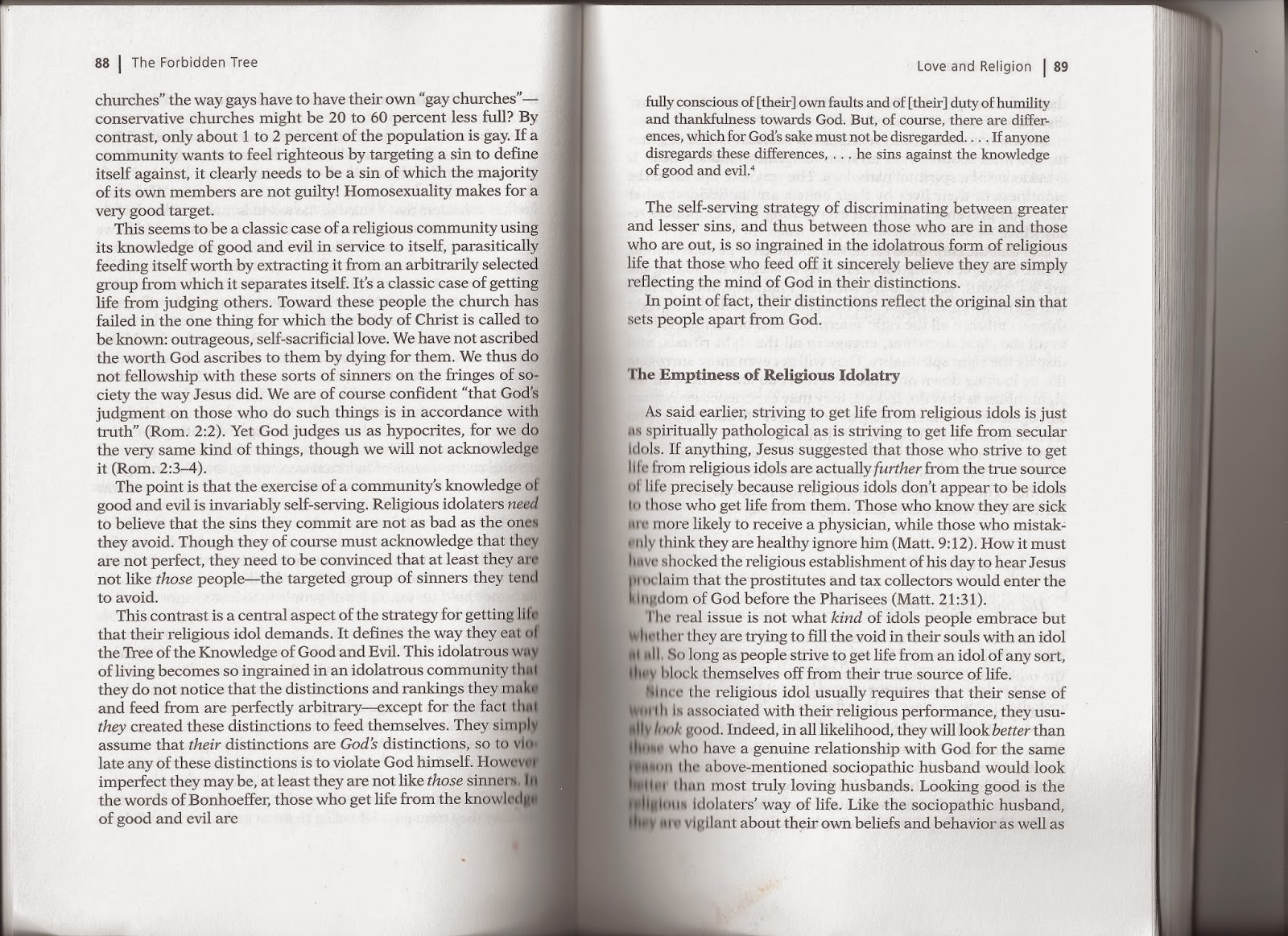
This entire section is powerful and pertinent to some conversations among evangelicals.  I will start by typing out the first few paragraphs before uploading scanned images of the next few pages. 

“Religious idolaters, of course, don’t recognize their idols as such.  On the contrary, part of their religious strategy for getting life is to contrast their ‘true’ beliefs and ethical behaviors with the idols to which secular people cling.  But as a matter of fact, religious idols are just as idolatrous as secular ones.  Indeed, this is the most prevalent and enslaving form of idolatry throughout history….
The standards used to judge others invariably favor the religious people doing the judging.  These standards are, after all, part of their strategy for getting life.  Hence, the sins a particular religious community is good at avoiding tend to be the ones identified as most important to avoid in the mind of that community, while the sins a community is not good at avoiding tend to be minimized or ignored altogether – regardless of what emphasis the Bible puts on these sins.
To give an example, few churches target overeating as sin.  Yet the Bible as a good deal to say about the sin of overeating (gluttony).  In the Jewish culture of Jesus’ day, the inability or unwillingness to control one’s eating was viewed as being on a part with the inability or unwillingness to control one’s sex drive.  Lust and gluttony were two major evidences that a person was undisciplined, governed by ‘shameless passion’ (Sir. 23:6; 4 Macc. 1:3,27).


If this section intrigues you, I strongly recommend that you read the rest of the book.  I’ve pulled another quote from pages 16 and 17 that sums up the goal of the book. 


“Whatever else Christians are known for, they are generally not known for their distinctive love.  Rarely are people drawn to the conclusion that Jesus is Lord simply because of the radical, God-like love the see among Christians and experience from Christians.
Why is this?  What keeps us from living in the place I described above [proving God is real through our love of others]… We position ourselves as judges of others rather than simply as lovers of others.  Our judgments are so instinctive to us that we usually do not notice them.  Even worse, they are so natural to us that when we do notice them, we often assume we are righteous for passing judgment?  Because of this, it is easy to overlook the fact that our judgments are blocking our love, keeping us asleep, preventing us from living in the truth God created us to live in.

We have failed to understand and internalize the biblical teaching that our fundamental sin is not our evil – as though the solution for sin was to become good – but our getting life from what we believe is our knowledge of good and evil.  Our fundamental sin is that we place ourselves in the position of God and divide the world between what we judge is to be good and what we judge to be evil.  And this judgment is the primary thing that keeps us from doing the central thing God created and saved us to do, namely, love like he loves.
Because we do not usually understand and internalize the nature of our foundational sin, we usually think our job as Christians is to embrace a moral system, live by it, and thus to be good people in contrast to all those who are evil.  In fact, I shall argue, God’s goal for us is much more profound and much more beautiful than merely being good; it is to do the will of God by being loving, just as God is loving.  More specifically, I shall show that God’s goal for us is to discover a relationship with him and thereby a relationship with ourselves and others that returns us to a state where we don’t live by our knowledge of good and evil.  Indeed, the goal is nothing less than for us to participate in the very love that the Father, Son, and Holy Spirit share throughout eternity.”


Pg. 89 into 90
[The Pharisees] are vigilant about their own beliefs ad behavior as well as those of other people.  The Pharisees looked better than Jesus’ disciples and the Pharisees knew it.
In fact, however, this hyper vigilance is evidence not of genuine spiritual health but of an inner emptiness and sickness.  It is evidence of a spiritual pathology.  The very attempt to fill the emptiness of their lives by their beliefs and behaviors rather than God prevents them from ever getting their emptiness really filled.
Not that the emptiness cannot be placated for periods of time; it can.  If people’s idolatrous religious strategies for getting life are successful, as they were with the Pharisees, these people will derive some surrogate life by believing they do all the right things, embrace all the right interpretations of Scripture, hold to all the right doctrines, engage in all the right rituals, and display the right spirituality.  They will get even more surrogate life by looking down on those who don’t do and believe all the right things as they do.  Indeed, they may experience even more surrogate life by entertaining a “holy anger” toward those who do not conform to their way of thinking and behaving (a fact that perhaps explains the remarkable divisiveness within Christianity).  But the positive feelings offered by religious idols are fleeting.  The emptiness returns, driving religious idolaters to further futile attempts to get life by their religion.


Pg. 192
For as a matter of fact, none of us have “arrived.”  It’s just that, for self-serving reasons, we’ve decided to categorize some sins – our sins – as acceptable and other sins – their sins – as condemnable.

If we view ourselves and everyone else through the lens of the cross rather than our knowledge of good and evil, we will see that our self-serving categorizations of sin are as unnecessary as they are illegitimate.  In Christ, we all stand condemned and forgive and righteous.  Hence, the prostitute, the greedy, the murderer, the obese, the homosexual, the rude, the unbathed, the drunk, the poor – even the Pharisee if he is willing – are to be welcomed back to the garden with enthusiastic celebration.

Pg. 197
If, for example, a church treats gays with the same compassion religious judges treat their own overweight people, its leaders will likely be condemned as “compromising the Word of God” by these judges.  Such a church is sinning against the (self-serving) knowledge of good and evil from which the religious judges feed.  Consequently, the judges will likely feel as though their god has been assaulted, and, as a matter of fact, it has!  As idolatrous people often do when their gods are threatened, they may rate.  They did so with Jesus and there’s every reason to believe they will do so with communities that look like Jesus.

Friday, August 22, 2014

When War is Unjust

I just finished the book "When War is Unjust: Being Honest in Christian Just War Theory" by premier teacher and writer on the subject of Jesus, violence and Just War Theory, John Howard Yoder.  While Yoder believes Christians are to follow Jesus' teaching and example by not participating in violence, he stated in another book that he should spend less time trying to convince people to not use violence and more time educating the on the Christian Just War Theory that most Christians claim to follow.  He realized that if Christians were educated on CJWT and committed to living it out, wars would be rare, if not non-existent.

Here are Yoder's thoughts on CJWT from this book.

Pg. 68
Counter to the standard history, the just-war position is not the one which has been taken practically by most Christians since Constantine.  Most Christians (baptized people) in most wars since pacifism was forsaken have died and killed in the light of thought patterns derived from the crusade or the national-interest pattern.  Some have sought to cover and interpret this activity with the rhetoric of the just-war heritage; others have not bothered.  The just-war tradition remains prominent as a consensus of the stated best insights of a spiritual and intellectual elite, who used that language as a tool for moral leverage on a sovereigns for whom the language of the gospel carried no conviction.  Thus just-war rhetoric and consistent pacifism are on the same side of most debates.  When honest, both will reject most wars, most causes, and most strategies being prepared and implemented.

Pg. 78
Does any church teach future soldiers and citizens in such a way that they will know beyond what point they cannot support an unjust war or use an unjust weapon?

Until today church agencies on any level have invested little effort in literature or other educational means to teach the just war limitations… The understanding of the just-war logic that led American young men to refuse to serve in Vietnam came to them not primarily from the ecclesiastical or academic interpreters of the tradition but rather from the notions of fair play presupposed in our popular culture.

Those who conclude, either deliberately or rapidly, that in a given situation of injustice there are no nonviolent options available, often do so in a way that avoids responsibility for any intensive search for such options.  The military option for which they so quickly reach has involved a long lead time in training and equipping the forces… Yet the decision that nonviolent means will not work for comparable ends is made without any comparable investment of time or creativity, without comparable readiness to sacrifice, and without serious projection of comparable costs.

Pg. 80
In sum, the challenge should be clear.  If the tradition which claims that war may be justified does not also admit that in particular cases it may not be justified, the affirmation is not morally serious.  A Christian who prepares the case for a justifiable war without being equally prepared for the negative case has not soberly weighted the prima facie presumption that any violence is wrong until the case for the exception has been made. 

Pg. 94
The Gulf War had a just motive, namely, counteracting an aggression, but “by its own inexorable inner logic” it escalated and inflicted unjustifiable levels of damage.  Thus the theory is “untenable and needs to be abandoned.”  The only justified war would be “pure defense against an aggression actually taking place.”  There are other remedies for the injustices war seeks to rectify.

The ideal appeal to institutions of world order, which, if they existed, ought to make war unnecessary, avoids coming to grips with the tragic choice of martyrdom when the good is authentically overwhelmed.

Pg. 95
Just war thinking:
- tends to obscure the ambiguity of justice claims in conflicts where typically both sides are responsible.
- tends to avoid the imperative of repentance, which is a precondition for reconciliation and self-restraint; thereby it fosters self-righteousness.
- tends to respond only to one episode instead of seeing events in historic continuity.
- condemns overt military action but not other (systemic, institutional) evils.
- credits the intention to avoid targeting the innocent without holding the belligerents responsible for actual disproportionate and/or indiscriminate consequences, undervaluing the suffering caused by calling it collateral or unintended.
-tends to reationalize unilateral action in an age when decisions should be shared.
We may note that while each of these observations implies a serious limitation to the adequacy of just-war thinking, they do not sweep it aside in favor of pacifism, realism, or something else.  If carefully taken account of, these considerations would contribute to a much more refined and dense just-war analysis, which could issue in a heightened capacity for restraint and a greater capacity to give one’s own government a blank check.

Walter Wink, another well-documented and empathetic interpreter, names the following shortcomings:
- No Christian body has ever used the just-war criteria to declare unjust any war in which its government was engaged.
- No war Christians have supported has in fact met the just-war requirements.
- No deliberative process appealing to the repertory of just-war criteria has taken place in the lead-up to any of the major wars of the West.
- The decisive criteria have no clear and objective definition; for example;
     What is the “legitimate authority” in settings of guerrilla insurgency?
     If “aggression” is always wrong, who really started this particular conflict?
     Does democracy change the definition of who the combatants are? 
     Does “total war” change the definition of noncombatancy?

Pg. 98
[There must be a] rejection of public triumphalism.  Back at the beginnings of the just-war tradition, Augustine commented that the acceptance of any killing was “mournful.”  Such regret in the face of killing even when justified was implemented by the rituals of penance for killing even in a just war.  Discerning observers of the American response to the 1991 Gulf War pointed out that a ticker-tape victory parade celebrated just days after tens of thousands of Iraqi deaths demonstrates that the resort to violence in that case was not reluctant and mournful, as the Christian case for just-war requires, but rather triumphal.  The same issues surfaced in Great Britian when some clergy refused to be as happy about the country’s victory over Argentina in the war for the Malvinas/Falklands as was Prime Minster Thatcher.

Pg. 110
In 1993, after the Gulf War, it judged that the bombing of civilian infrastructure, the most morally problematic issue to arise from the Gulf War, “can amount to making war on noncombatants.”

Pg. 112
A particularly serious gap is any lack of provision under US law for selective conscientious objection, that is, objection to military service in particular circumstances because of a conscientious judgment that a given war or military action is contrary to just-war norms.  The Catholic church in the United States has long sought such protection as a corollary to the acceptance of the just-war tradition.
Simply put, if it is morally and even obligatory to engage in a just-war, then it is morally impermissible to participate in an unjust one and one would be morally required to refuse to serve under such conditions.
The failure of the military to revise its own regulations to process selective conscientious objectors, and of the Congress to allow for selective objection on just-war grounds continues to put those who adhere to the just-war tradition in jeopardy.

Pg. 114
In a culture of violence, to be sure, the uses of the just-war tradition can easily degenerate into “a weapon to justify a political conclusion or a set of mechanical criteria that automatically yields a simple answer” quite inconsistent with the underlying intention of the tradition to prevent conflict and to discern the moral limits of justifiable force.

Catholic teaching affirms that “a citizen may not casually disregard his country’s conscientious decision to call its citizens to legitimate acts of defense.”
At the same time, the teaching maintains that “no state may demand blind obedience.”  Accordingly, as we have seen, the church in the United States has actively supported legal protection of those who conscientiously refuse to participate in any war (conscientious objectors) as well as for those who cannot, in good conscience, serve in specific conflicts they consider unjust or in branches of the service (e.g. strategic nuclear forces) which are required to carry out morally repugnant policies (indiscriminate killing).

Pg. 116
In sum, civilian leaders and officials, like military personnel, should be prepared to bear the onus of selective conscientious objection.  While the price one may pay today is not as heavy as it once was, the effectiveness of the just-war tradition as a system of moral constraints on the use of force depends very much on the willingness of conscientious men and women to pay a price for their moral convictions.

Sunday, August 10, 2014

Christ and Violence by Ronald J Sider

I just finished a short but powerful book by Ronald Sider, Christ and Violence.
Here are some of the better quotes from this book.

Pg. 24
[Jesus] informed Pilate that His kingdom was not of this world in one specific regard – namely that His followers did not use violence (John 18:36).  Obviously He did not mean that the messianic kingdom He had inaugurated had nothing to do with the earth.  That would have contradicted His central announcement of the eschatological Jubilee which He expected His followers to begin living.  But He did mean that He would not establish His kingdom by the sword.
To a people so oppressed by foreign conquerors that repeatedly over the previous two centuries they had resorted to violent rebellion, Jesus gave the unprecedented command: “Love your enemies.” 

Pg. 25
Jesus’ way is entirely different.  For the members of Jesus’ beginning messianic kingdom, neighbor love must extend beyond the limited circle of the people of Israel, beyond the limited circle of the new people of God!  All people everywhere are neighbors to Jesus’ followers and therefore are to be actively loved.  And that even extends to enemies – even violent oppressive foreign conquerors!
It is exegetically impossible to follow [Martin] Luther’s two kingdom analysis and restrict the application of these verses on love of enemies to some personal sphere and deny their application to violence in the public sphere.
As Eduard Schweitzer says in his commentary on Matthew, “There is not the slightest hint of any realm where the disciple is not bound by the words of Jesus.”
Pg. 27
The radical, costly character of Jesus’ call for love toward enemies certainly tempts us to decisively weaken Jesus’ message by labeling it an impossible ideal, relegating it to the millennium, or limiting its application of personal relationships.  But that is to misread both the text and the concrete historical context in which Jesus lived and spoke.  In his original setting, Jesus advocated love toward enemies as His specific political response to centuries of violence and to the contemporary Zealot’s call for violent revolution.  And He spoke as one who claimed to be the Messiah of Israel.  His messianic kingdom was already breaking into the present, and therefore His disciples should and could live out the values of the New Age.
To be sure, He did not say that one should practice loving nonviolence because it would always instantly transform enemies into bosom friends.  The cross stands as a harsh reminder that love for enemies does not always work – at least in the short run. 
Pg. 30
It was the resurrection which convinced the discouraged disciples that in spite of the cross, Jesus’ claims and His announcement of the messianic kingdom were still valid.

Pg. 34
Because Jesus commanded His followers to love their enemies and then died as the incarnate Son to demonstrate that God reconciles His enemies by suffering love, any rejection of the nonviolent way in human relations involves a heretical doctrine of the atonement.  If God in Christ reconciled His enemies by suffering servanthood, then those who want to follow Christ faithfully, dare not treat their enemies in any other way.
It is a tragedy of our time that many of those who appropriate the biblical understanding of Christ’s vicarious cross fail to see its direct implications for the problem of war and violence.  And it is equally tragic that some of those who most emphasize pacifism and nonviolence fail to ground it in Christ’s vicarious atonement…
Certainly the once-for-all sacrifice of Christ for the sins of the world was a unique element of His cross that could never be repeated. But that fact never prevented the New Testament authors from discerning in the cross a decisive ethical clue for the Christian’s approach to opponents and enemies, indeed even friends, spouses, and fellow members of Christ’s body.

Pg. 38
In every strand of New Testament literature and with reference to every kind of situation (whether family, church, state, or employment), the way of the cross applies.  Jesus’ cross, where He practiced what He had preached about love for one’s enemies, becomes the Christian norm for every area of life.  Only if one holds biblical authority to irrelevant that one can ignore explicit, regularly repeated scriptural teaching; only if one so disregards Christ’s atonement that one rejects God’s way of dealing with enemies; only then can one forsake the cross for the sword.
To be sure, church history is a sad story of Christians doing precisely that.  After the first three centuries when almost all Christians refused to participate in warfare, Christians repeatedly invented ways to justify violence.
And each of us if we think honestly about the costly implications of suffering servanthood, will understand within ourselves how temptingly plausible it is to consider Jesus’ nonviolent way in an impossible ideal, a utopian vision practiced only in the millennium, or some idealistic teaching intended only for personal relationships. But if one recalls Jesus’ historical context, one simply cannot assert that this is what Jesus Himself meant.  Claiming to be their Messiah, He came to an oppressed people ready to use violence to drive out their oppressors.  But He advocated love for enemies as God’s method for ushering in the coming Kingdom.  And He submitted to Roman crucifixion to reconcile His enemies.

Pg. 44
I think activist nonviolence rather than nonresistance is the more faithful application of the New Testament teaching.

Pg. 45
Lethal violence is different.  When one kills another person, one treats him as a thing, not a person.  Hence Jesus’ teaching excludes lethal violence as an acceptable option for Christians.

Pg. 47
Indeed, one should love one’s enemies, even at great personal cost.  The good of the other person, not one’s own needs or rights, are decisive.

Pg. 48
Thus Jesus’ saying is compatible with the use of economic, legal, or political power to oppose evil as long as love for the oppressor as well as the oppressed is both the means and the end.

Pg. 55
This eschatological hope for the restoration of the whole of creation including the principalities and powers underlines the fact that the Christian dare not choose between a creation ethic and a kingdom ethic.

Pg. 57
To announce Christ’s lordship to the principalities and powers is to tell governments that they are not sovereign…
Again, it is clear that merely to witness in a biblical way to the principalities and powers is to engage in dangerous, subversive political activity.
But is that all we are to do? Is it correct to say that we should witness to the state and other principalities and powers but not take the offensive against them?  I think not.  I doubt that the absence of offensive weapons in Ephesians 6:10-20 means that we are merely to defend ourselves against the powers.  Everyone agrees that we are to witness boldly to the powers.  But surely that is an offensive act, not a defensive one.  One can take the offensive with words just as much as with actions.  Ephesians 6 calls us to arm ourselves with the truth, with the gospel, and with the Word of God.  The kind of words we are summoned to speak to the powers surely involves taking the offensive unless one wrongly supposes that bold proclamation is merely a defensive approach.

Pg. 59
In reference to Romans 13
Neither Jesus nor the early church ever supposed that to be subject to government meant to obey its every command.  Jesus and the apostles knew that whenever government commanded what was contrary to God’s command, it must be disobeyed.  “We must obey God rather than men” (Acts 5:29) was their working principle.  But even in their refusal to obey, even in their civil disobedience, they continued to be subject to government.  They did not rebel.  They did not take up the sword to overthrow government.  On the other hand, when government commanded things contrary to God’s will they regularly refused to obey, and then accepted the penalty for their disobedience.

Pg. 60
We should resist the evils promoted or perpetuated by governments.  We dare not rebel against government and cast off its authority.  We can and should try to make our government – no matter how good or bad it is – more just.  We dare not – however unjust it may be – try to destroy it.  We can engage in political lobbying, voter power, economic boycott, political demonstration, civil disobedience, tax refusal, even total noncooperation and still be subject to our government.  As long as the methods are those of loving nonviolence, as long as we refuse to consider the oppressor an enemy, as long as we submissively reject rebellion and instead respectfully accept the penalties that are imposed, we remain subject to government.  Scripture commands us always to be subject to government.  It does not command us to obey without condition.  And wholehearted subjection to government is fully compatible with the most vigorous nonviolent resistance to governmental injustice because the goal is not rebellion but improvement of the government to which was are subject precisely as we resist.

Pg. 63
Precisely as we plunge deeper into the centers of power of secular society, we will need even more urgently to strengthen the church as a counterculture of Christians whose visible commitment to the radical values of Jesus’ new kingdom is so uncompromising that the church’s very existence represents a fundamental challenge to surrounding society.  Unless we are based in that kind of kingdom counterculture, our movement into society will be useless because we will merely become one more empty echo of an unjust status quo. But that need not happen if we maintain the sharp biblical distinction between the church and the world and if our primary identity and allegiance remains with Jesus’ new community of believers.
Pg. 67
Probably few people reading this book will have killed another person.  Many would choose going to jail rather than going to war.  But joining the army is not the only way to participate in murder.  Established economic structures can destroy people by the millions.  Slavery did that.  Child labor did that.  Both were as legal as they were lethal.  Legal structures can be violent.  Therefore we must face a very painful question: Do we participate in economic structures that help destroy millions of people each year?

Pg. 68
Not even the Dominicans who work on the sugar plantations have profited.  The sugar plantation workers earned less in real wages in 1978 than they did in 1968 – in part because the Dominican government installed by U.S. marines have destroyed the cane cutters’ labor union.  The U.S. has invested more money per capita for police training in the Dominican Republic than in any other Latin American country.  And those police have made widespread use of torture to suppress any opposition to the dictatorship which ruled for over a decade.  Fortunately that government was replaced in 1978, thanks in part to President Carter’s vigorous support of the results of an election which the armed forces wanted to annul.  But that former government has made it possible for Gulf and Western to use a vast part of the country’s best land to grow sugar for you and me at a handsome profit to the company.
Now who is responsible for the thousands of Dominican children who die each year of malnutrition?  Just the top leaders at Gulf and Western?  Just the Dominican Republic’s elite who profit by cooperatin with Gulf and Western?  Or are you and I also implicated?
Jacques Ellul has pointed out that unjust economic systems can be as violent as rampaging armies:  “I maintain that all kinds of violence are the same... the violence of the soldier who kills, the revolutionary who assassinates; it is true also of economic violence – the violence of the privileged proprietor against his workers, of the ‘haves’ against the ‘have-nots;’ the violence done in international and economic relations between our societies and those of the third world; the violence done through powerful coporations which exploit the resources of a country that is unable to defend itself.”  One can only agree with James Douglass:
“In the contemporary world of affluence and poverty, where man’s major crime is murder by privilege, revolution against the established order is the criterion of a living faith.  ‘Truly I say to you, as you did it not to one of the least of these, you did it not to me’ (Matt. 25:45).  The murder of Christ continues.  Great societies build on dying men.”

Unfortunately it is not true that our society’s wealth is simply the result of God’s blessing and hard work.  To a significant extent, our affluence depends on unjust economic structures that make us rich and Latin Americans hungry.  Fully one half of all the cultivable land in Central America is used to grow export crops (sugar, coffee, bananas, flowers, and the like) to sell to the U.S., Canada, and other rich nations.  That land ought to be used to grow food for the masses in Central America where 60 percent of the children die of malnutrition before they are five years old.  But it is used to grow sugar and coffee and bananas for North Americans because we can pay for it and the starving children’s parents cannot.

Pg. 70
There is an important difference between consciously willed, individual acts (like lying to a friend or committing an act of adultery) and participation in evil social structures.  Slavery is an example of the later.  So is the Victorian factory system where ten-year-old children worked twelve to sixteen hours a day.  Although both slavery and child labor were legal, they destroyed people by the millions.  They represent institutionalized violence or structural evil.  Tragically, most Christians seem to be more concerned with individual sinful acts than with participation in violent social structures.
But the Bible condemns both.  Speaking through His prophet Amos in Amos Chapter 2, the Lord declared,
6 This is what the Lord says:
“For three sins of Israel,
    even for four, I will not relent.
They sell the innocent for silver,
    and the needy for a pair of sandals.
7 They trample on the heads of the poor
    as on the dust of the ground
    and deny justice to the oppressed.
Father and son use the same girl
    and so profane my holy name.
Biblical scholars have shown that some kind of legal fiction underlies the phrase “selling the needy for a pair of sandals.”  This mistreatment of the poor was legal!  In one breath God condemns both adultery and legalized oppression of the poor.  Sexual sins and economic injustice are equally displeasing to God.
Some young activists have supposed that as long as they were fighting for the rights of minorities and opposing militarism, they were morally righteous regardless of how often they shacked up for the night with a guy or a girl in the movement.  Some of their elders, on the other hand have supposed that because they did not lie, steal, and fornicate, they were morally upright even though they lived in segregated communities and owned stock in companies that exploit the poor of the earth. God however, has shown that robbing one’s workers of a fair wage is just as sinful as robbing a bank. 
God clearly revealed that laws themselves are sometimes an abomination to him.
Psalm 94
20 Can a corrupt throne be allied with you—
    a throne that brings on misery by its decrees?
21 The wicked band together against the righteous
    and condemn the innocent to death.
22 But the Lord has become my fortress,
    and my God the rock in whom I take refuge.
23 He will repay them for their sins
    and destroy them for their wickedness;
    the Lord our God will destroy them.

pg. 72
God proclaims the same word through the prophet Isaiah:
Isaiah 10:1-4
Woe to those who make unjust laws,
    to those who issue oppressive decrees,
2 to deprive the poor of their rights
    and withhold justice from the oppressed of my people,
making widows their prey
    and robbing the fatherless.
3 What will you do on the day of reckoning,
    when disaster comes from afar?
To whom will you run for help?
    Where will you leave your riches?
4 Nothing will remain but to cringe among the captives
    or fall among the slain.
Yet for all this, his anger is not turned away,
    his hand is still upraised.

There is one other aspect to institutionalized violence or structural evil which makes it especially pernicious.  It is so subtle that one can be ensnared almost without realizing it.
God inspired His prophet Amos to utter some of the harshest words in Scripture against the cultured, kind, upper-class women of his day:
Amos 4:1-2
Hear this word, you cows of Bashan on Mount Samaria,
    you women who oppress the poor and crush the needy
    and say to your husbands, “Bring us some drinks!”
2 The Sovereign Lord has sworn by his holiness:
    “The time will surely come
when you will be taken away with hooks,
    the last of you with fishhooks.
The women involved probably had no contact with the impoverished peasants. They may never have realized clearly that their gorgeous clothes and spirited parties were possible only  because of the seat and tears of toiling peasants.  In fact, they may even have been kind to individual peasants they met.  (Perhaps they gave them “Christmas baskets” – once  year).  But God called these privileged women cows because they profited from structural evil.  Hence they were personally and individually guilty before God.
We must conclude, I think, that if we are members of a privileged class that profits from structural violence and if we do nothing to try to change things, then we stand guilty before God.  Structural evil is just as sinful as personal evil.  And it hurts more people and is more subtle.

Pg. 76
We are all implicated in structural evil.  The patterns of international trade are unjust.  An affluent minority devours most of the earth’s nonrenewable natural resources.  And the food consumption patterns in the world are grossly lopsided.  Every North American benefits from these structural injustices.  Unless you have retreated to some isolated valley and grow or make everything you use, you participate in unjust structures which contribute directly to the hunger of a billion unhappy neighbors.
But that is not God’s last word to us. If there were no hope of forgiveness, admission of our complicity in guilt of this magnitude would be an act of despair.  But there is hope – if we repent. 

Pg. 77
We need change at three levels: 1) our personal lifestyles, 2) the church, and 3) secular society.  In each case, the goal is peacemaking… First we need to pursue simpler personal lifestyles.  As the Catholic saint, Elizabeth Seton, has said, “The rich must live more simply that the poor may simply life.”

Pg. 79
It is a farce to ask Washington to legislate what the church refuses to live.
The church should consist of communities of loving defiance.  Instead it consists largely of comfortable clubs of conformity.  A far-reaching reformation of the church is a prerequisite if the church today is to commit itself to Jesus’ mission of liberating the oppressed.
The God of the Bible is calling Christians today to live in fundamental nonconformity to contemporary society.  Affluent North American society is obsessed with materialism, sex, economic success and military might.  Things are more important than persons.  Job security and an annual salary increase matter more than starving children and oppressed peasants.  Paul’s warning to the Romans is especially pertinent today: “Don’t let the world squeeze you into its own mold” (Romans 12:2; Phillips).  Biblical revelation summons us to defy many of the basic values of our materialistic adulterous society.

Pg. 89
It is in that kind of [small group] setting – and perhaps only in that kind of setting – that the church today will be able to forge a faithful lifestyle for Christians in an Age of Hunger.  In small house-church settings, brothers and sisters can challenge each other’s affluent lifestyles.  They can discuss family finances and evaluate each others’ annual budgets.  Larger purchases (like houses, cars, and long vacations) can be evaluated honestly in terms of the needs of both the individuals involved and God’s poor around the world.  Tips for simple living can be shared.  Voting patterns that liberate the poor, jobs that are ecologically responsible, charitable donations that build self-reliance among the oppressed and direct actions campaigns that successfully challenge unjust multinational corporations – these and many other issues can be discuppes openly and honestly by persons who have pledged themselves to be brothers and sisters in Christ to each other.
My second proposal on the church begins with the assumption that it is a tragic farce for the church to ask Washington to legislate what it cannot persuade Christians to live.

Pg. 83
The United States has trained large numbers of police who have tortured thousands of people working for social justice in countries like Chile and Brazil.  Multinational corporations in the United States work very closely with the repressive governments.  Events in Brazil and Chile demonstrate that the United States will support dictatorships that use torture and do little for the poorest one half as long as those regimes are friendly to U.S. investments.

Pg. 85
Our most fundamental Christian confession is that Jesus is Lord.  But He won’t be Lord of our family life and allow radio and TV commercials to be Lord of our family budget and multinational corporations to be Lord of our business practices.  If Jesus is our Lord, then He must be Lord of our business practices, our economic lifestyle, Lord of our entire life.
The Historical Peace Churches are a biblical people who have opposed theological liberalism.  But still I’m afraid that we are in danger of falling into theological liberalism today.  We usually think of theological liberalism in connection with issues like the bodily resurrection and the deity of Jesus Christ.  And that is correct.  Theological liberals have fallen into terrible heresy in recent times by rejecting those basic doctrines of historic Christianity.  But notice why that happened.  Modern people became so iof impressed with modern science that they thought they could no longer believe in the miraculous.  So they discarded the supernatural aspects of Christianity and abandoned the resurrection and the divinity of Christ.  They allowed the values of surrounding society rather than biblical truth to shape their thinking and acting.  That is the essence of theological liberalism.  In our time, we are in desperate danger of repeating exactly the same mistake in the whole area of justice and the poor.  We are allowing surrounding society rather than Scripture to shape our values and life.  Have not our economic lifestyles and our attitudes toward the poor been shaped more by our affluent materialistic society than by Scripture – even though the Bible says as much about this set of issues as it does about the atonement or Christology?
If we want to escape theological liberalism, if our confession that Jesus is Lord is genuine, then we must cast aside the secular economic values of our materialistic society.  Now I know many of the people in our churches don’t want to do that.  They don’t want to hear the Bible’s radical call to costly discipleship.  But that simply raises in a more painful way for every church leader the basic question: Is Jesus really our Lord?
Many pastors, Sunday school superintendents, and other church leaders agree that we should be concerned with the poor and work for peace via justice.  They are willing to talk carefully about these things as long as the message is not too upsetting to the congregation, as long as it does not offend potential new members and hinder church growth.  But they don’t make it clear, as Jesus did, that we really have to choose between Jesus and Mammon.  They are afraid to teach and preach the clear biblical word that economic systems perpetrate instutionalized violence and murder because that would offend business people.  One wonders whether it is Jesus or church growth, whether it is Jesus or vocational security, whether it is Jesus or social acceptance who finally is our Lord.

Pg. 87
Is Jesus or surrounding society our Lord?  If we intend to follow the risen One, then I think we will discover that He calls us to be peacemakers through economic change – through more simple personal economic lifestyles, through more simple church lifestyles, and through action designed to change economic systems that produce violence by statute.

Pg. 99
I dream of a time when it will be the norm rather than the exception for our people to authenticate our word about peace with lives of costly, nonviolent identification with the oppressed.  For tens of thousands that will mean leaving comfortable rural or suburban surroundings to join the poor of the earth in their struggle for justice – by making our homes in the black or Spanish speaking inner cities, in the Appalachian Highlands, in unjust third word settings.  When tens of thousands of our people have done their homework so they are competent to discuss pending legislation with Senators, when tens of thousands of our people are going to jail, when we are being tortured and getting martyred in a nonviolent struggle for justice in the inner cities and the third world, then we will have the right to talk about nonviolence.
Of course, not all of us should move.  For others, identifying with the oppressed will mean talking and working against unjust structures here and abroad so persistently and single-mindedly that our scholarly societies, our professional colleagues, our business associates and political friends will discover that we worship the God of the poor not success, that we will accept social disgrace, professional failure, unemployment, even imprisonment for civil disobedience rather than forsake our identification with the oppressed.


Tuesday, August 5, 2014

Allah: A Christian Response

I recently finished a fascinating book “Allah:  A Christian Response” by renowned theologian Miroslav Volf.  The book is very much worth the read, as Volf tackles the theological question of whether Muslims and Christians worship the same God, though they clearly  have some different perspectives on God.  By the way, the title “Allah” is simply Arabic for God, just like “Theos” is Greek for God or “Dieu” is French for God.  In fact, Arabic speaking Christians also use the title “Allah” to refer to the God worshipped by Christians and Jews. 

I won’t go into all the theological arguments of the book, though I would recommend the time and energy necessary for wading through Volf’s arguments, but in keeping with a main theme of this blog, I will share some of the quotes on the Christian call to love our enemies and to avoid violence.  The call to love our enemies has a particularly poignant applicability when dealing with Muslim extremists. 

Enjoy the quotes.  And have I mentioned this book would be worth a read?  Well, it is. 
Pg. 177
God’s love for the ungodly and human love for enemies are inextricably tied together.  Over the centuries, Christians have not been very good at loving their enemies, to say the least.  We have left a trail of blood and tears as we have marched through history.  Still, human disobedience doesn’t annul the divine command, especially not a command that is so close to the center of the gospel and so bound up with the nature of God.  That’s why even those who transgressed egregiously the command to love enemies still felt compelled to try to reconcile their conduct with the command.  For example, in a letter to Sultan Mehmet II after the Ottoman leader had sacked Constantinople in 1453, Pope Pius II noted, “We are hostile to your action, not to you.  As God commands, we love our enemies and we pray for our persecutors.”  At the same time, the pope went on organizing a crusade against the mighty sultan – which is not, in my judgment, the way to love an enemy.

Pg. 178 –
The point of loving one’s enemies – of “repaying” persecution with blessing, and wrongdoing with forgiveness – is not to put up with evil.  It is to resist being “overcome with evil” and to “overcome evil with good” (Rom. 12:21).  Martin Luther makes the point eloquently.  The followers of Christ are supposed to “grieve more over the sin of their offenders than over the loss or offense to themselves. And they do this that they may recall those offenders from their sin rather than avenge the wrongs they themselves have suffered.  Therefore they put off the form of their own righteousness and put on the form of those others, praying for their persecutors, blessing those who curse, doing good to the evildoers, preparing to pay the penalty and make satisfaction for their very enemies that they may be saved.  This is the Gospel and the example of Christ.” 
The ultimate purpose of loving one’s enemies is clear: “that they may be saved” from their evildoing and that goodness may triumph.

Pg. 179 -
In New Testament times, Christian communities were a persecuted minority with no aspirations to become a political or military power.  If any fighting were to be done to protect those communities or if any retribution were to be exacted to avenge the injuries they suffered, God was the one, not them, to fight and to exact retribution (see Rom. 12:19; Rev. 19:2).  Violence against enemies was displaced onto God.  God fights Christians do not – neither in their own name nor in the name of God.

Pg. 180 -
“As Muslims,” they [many Muslims] write, “we say to Christians that we are not against them and that Islam is not against them – so long as they do not wage war against Muslims on account of their religion, oppress them and drive them out of their homes.”  Muslims are “not forbidden” from “dealing kindly and justly” with those who are “just” toward them (Al Mumtahinah, 60:8).  Muslims can be kind to non-Muslims as long as they are not against Muslims.  But Muslims are against those who wage war against them.  This is an understandable stance, and it is compatible with the requirements of justice.  But that’s not love for one’s enemies as Christians understand it.  To love, we have to be for someone.  That is the teaching and the example of Christ.  For Christians, this is not just a noble way to live out one’s faith, a supererogatory act, but an explicit and repeated command of God.

Pg. 203 -
Prejudices are errors born of ignorance, self-absorption, resentment, and fear – all stances incompatible with the active love of neighbor enjoined on Muslims and Christians alike by their common God.  The best way to fight prejudice is by knowledge – not just knowledge of people’s beliefs and practices, but knowledge of their feelings and hopes, their injuries and triumphs as well.

Pg. 212 -
It is wrong to compare the best practices of one’s own faith with the worst practices of the other faith.

Pg. 241 -
Religion, as seen as a marker if identity (see Chapter 10), has swallowed up allegiance to the common God.  Even though God is on everybody’s lips, religion has become the godless (or maybe religion is godless partly just because God is on everybody’s lips).  The consequence?  Each community thinks only of its own injuries and hopes, pursuing only its own interests and its own good.  Neither cares for the other or for the common good.  It would take all allegiance to God in love and fear to cure them from self-preoccupation and excessive fear of others, my friend suggested.  To care for the common good, and not just for our own good, in the face of powerful impulses to protect the group and enhance its power, the God of truth, justice and love must claim us.

Pg. 256 -
Extremism does not have a single cause, (say, perceived injustice suffered or dangerous religious convictions); it always has multiple causes – political, economic, cultural, religious, and more.  And if the causes are many, the solution cannot be one.  Multipronged approaches are necessary – from struggles for greater justice in international relations, to the re-crafting of political institutions, to reforming judicial systems, to improving the quality of education and media, to fostering religious understanding and the purification of religious convictions.
Now the exception.  I reject military approaches to combating extremism, though I support nonmilitary coercive measures, such as policing and economic sanctions.  Far from being effective in combating extremism, the use of military force only exacerbates the problem.  If I am correct – I am aware that I am making a controversial claim and that people much more knowledgeable than I disagree with me – that’s an important pragmatic reason against military solutions.  But in my judgment, moral reasons are even weightier than pragmatic ones.  The war in Iraq, partly waged to combat extremism, was an unjust and therefore morally unacceptable war; to a lesser degree the same is arguably true of the war in Afghanistan.
There is a consistent Christian tradition, prevalent in the early church and then resurfacing during the Protestant Reformation, that condemns all use of military force as incompatible with the way of Christ.  But even from a classical Christian perspective, shaped by Augustine, which embraces the just-war idea, these wars or any other wars that may be waged to combat extremism must be condemned as unjust and incompatible with Christian convictions.  Some key criteria for just war cannot be met – above all, just cause for war (because combating extremism through military means as a rule involves preemptive use of force) and immunity for noncombatants (because terrorists hide among civilians), to name just two.  At best, what could be defended within that tradition is targeted attacks against terrorists themselves or their direct supporters.

Pg. 258 -
To start with, remember this is a book written by a Christian and addressed to Christians.  It is a Christian take on Muslim’s convictions, an account of how Christians should relate to Muslims, not  prescription for what Muslims should believe and how they should live.  Can a book addressed to Christians have any bearing on Muslim extremism?  It can.  Note that highly negative views of Islam are widespread among Christians.  True, I know of no Christian who acts on these views by using terrorist means, but many do so by inflammatory rhetoric and advocating an all-out clash between Muslim and Christian civilizations.  Extremism on one side often feeds extremism on the other side; negative views and negative actions often elicit corresponding and even augmented negative view and actions in return.  So combating highly negative – and importantly, inaccurate and prejudiced – Christian views of Muslims is a significant contribution to combating Muslim extremism.

Sunday, August 3, 2014

Returned, Finally (part deux)

"Guess who's back, back again?"

We are back in Gardner after finishing our year in France.  It was an incredible year that I will not try to summarize here but will simply direct you to the blog I kept during the year, http://millermissioncorps.wordpress.com/.

We are about to embark on another European adventure, this time with MNU Europe.   I was thinking that I'd continue blogging about MNU Europe on the other site, but since I posted so many pictures I've used up almost all of the storage, I think I'll jump back on this blog.

I will also continue to post on issues of justice and nonviolence, including notes from the books I'm reading.  

We also have a new ministry adventure we're pursuing, though it won't start until we return from Europe in September.  So more on that later.

In the meantime, I'll work to get some content going again on this blog.