Showing posts with label Boyd. Show all posts

Tuesday, February 13, 2018

Disciplines for 2018

This post first began writing itself in the far corners of my mind back on Friday, Dec 29th. A pastoral couple, clients of mine, got me into a smaller group meeting with Francis Chan.  If you're familiar with Francis Chan's speaking and writing, what I'm about to share won't be surprising, but in the middle of his talk, something lit up inside of me.  I became fully aware of just how long I'd been coasting, how atrophied I'd become in allowing our present relationship to be based upon a trust in God's unconditional love (not to downplay that realization, mind you) and a somewhat distant memory of intimacy.  It was like a pilot light being lit again in a cold and dark basement; the subtle rush of that woosh and the flicker of the small flame betraying the intensity of the heat about to start emanating from a newly renewed source of power.

Although, to be chronologically accurate, it might be better to describe that afternoon as the final adrenaline kick to a season of renewal that had gotten off to a half-hearted start a few months earlier.  Sometime back in November, I started spending about 30 minutes each morning practicing a version of the disciplines laid out in the book, Miracle Morning.   Here's a brief overview of that morning routine:
1) 5-15 minutes in silent prayer and meditation.  Sitting in meditative pose while repeating breathe prayers; "Lord Jesus Christ, Son of the Living God, have mercy on me, a sinner" or "I breath in Your love, I breath out Your peace."  A focus on God's living presence, a release of tension and worries or as the author described the practice of mediation, "a vacation from your problems."
2) Five minutes of journaling what I'm thankful for and how God has recently used me to serve the Kingdom.  In one of those "coincidences" that seem to happen when I'm actively pursuing God, I heard this sermon on how thankfulness rewires your brain just as I started this new discipline.
3) Five minutes of positive visualization.  I have to say, I still struggle with this.  Again, maybe a coincidence, but it helped me work through some really tough and volatile sales transactions.  Did the visualization bring the positive outcomes into reality?  Likely not.  I'm certain, though that the visualization allowed me to stay positive during some highly stressful situations.
4) Affirmations.  This is the rather cliche-ish, sales-man-y discipline but, again, the positivity is helping rewire the often-prone-to-negativity brain of mine.  I've found myself, when wanting to do the opposite of my affirmations, unconsciously reciting them in my mind, which allowed me to do the kind or difficult thing, despite not feeling like doing so, i.e. turning in that final French paper or apologizing to the mother of my son for a snide remark.

The "I'm-no-longer-coasting" and "turn-your-face-toward-the-Father" discipline that was catalyzed by the talk from Francis Chan is the discipline I've been practicing in the evening, about an hour or so before going to bed.  Again -  stop me if you've heard this before - while feeling that renewed passion inside of me but not yet sure how to direct that passion, I heard another sermon from Greg Boyd about the discipline of the daily review.
I spend 15 minutes each evening reviewing my day, listing out the major events of the day and then writing out my own reaction to those events and my perception of how the Spirit was active in each of them.  I'll finish by reading a lectionary passage or two for the upcoming Sunday.
As I write this, it's dawning on me that I'm simply describing a practice of prayer, journaling and Bible reading.  Real innovative and profound, I know.  Maybe I can make it sound a bit more high-minded by describing it as a version of a daily St. Ignatius Examen.  Maybe.
What has me most excited about this, though is how Greg Boyd stated in that sermon that the journaling will provide a historical record of how God's presence has been with me through this current journey.  As  I wrote about in the shame post, it's been awhile since I've been aware of, or even wanted to be aware of, that Presence.

There's another discipline I've added at the start of the year, too and it's not really something I enjoy - swimming.  A buddy in the office, another agent, convinced me to do the sprint portion of the KC Triathlon in May.  Running a 5K after 12 miles on a bike shouldn't be too bad and will likely only take about a month's worth of training (or that's what I'm telling myself right now, as I haven't yet started training for that portion of the race) but the swimming might damn near kill me.  I've heard drowning is one of the most painful ways to die.  While I haven't yet drowned, I have swallowed about half the water in the YMCA lap pool.  Thankfully, a lifeguard took pity on me and taught me how to float on my side for a bit, with one arm extended forward, while regaining my breath.  I don't care if I finish last but I will make that swim.  It's only 500 freakin' meters.  In my current state of swimming capacity, however it might as well be 10 miles.

While waiting to find out whether or not I drown, you can get motivated by reading the daily affirmations I tell myself each morning.  Or just roll your eyes at the over-the-top positivity, as I'd do were the roles reversed...


Relationships
- I enjoy spending time with God each day, through scripture reading and mediation/prayer
- I enjoy being present, patient and emotionally available for Dawson; parenting through choices and not control
- I enjoy being in a stable, healthy, long-term relationship but for now, I’m okay with being single
- I enjoy being kind to and getting along with my ex-wife

Service
- I enjoy spending time each week serving others by helping at church and spending time with and helping feed the hungry and homeless

Enrichment
- I enjoy playing the piano consistently
- I enjoy reading consistently
- I enjoy improving my French/working on a degree
- I enjoy writing consistently

Fitness
- I enjoy lifting weights twice a week
- I enjoy weighing 193lbs
- I enjoy making good food choices
- I will swim 500 meters

Career/Money
- I enjoy earning enough money for a comfortable living
- I will sell six listings this year
- I will sell 4 million in 2018
- I will develop a rental property base as a source of income
- I enjoy making my daily contacts

Friday, September 5, 2014

Life-Changing Love

Here are some more notes from the Greg Boyd book I've been working through, "Repenting of Religion."

This is a great description of the type of love that is to mark our Christian communities.

Pg. 200
The evangelistic task of the Christian community, in other words, is to live and love in a way that draws people and cries out for explanation.  Our proclamation only has as much credibility as our love requires explanation.
This is not because the world is so sinful that people unjustly require an unreasonable demonstration of truth before they believe it.  For too long, the church has blamed the world for how ineffective it is at attracting people.  Evidence that we have been eathing from the same tree from which Adam and Eve ate is that we have deflected responsibility for our sin just as they did.  In truth, if people aren’t being drawn to the Lord by the church’s love, this is the church’s fault.  For Jesus taught us from the start that it is by our love, not just by our words, that people will know he is real and be drawn into a relationship with him.  Christ convinced us of the love of God by demonstrating it while we were yet sinners.  We are called to do the same toward others.
By God’s own design – a design that recaptures the purpose for which God created the world – hurting and hungry people are to be drawn into the reality of God’s love by seeing it demonstrated in his body.  Christ did this in his earthly body, which is why sinners were attracted to him.  And he longs to do this again through his church boy.  To the extent that the church embodies the spirit of Jesus, it will be a magnet for prostitutes and tax collectors.  To the extent it embodies the spirit of Pharisaism, however, it will repel life.

Tuesday, August 26, 2014

Homosexuality and Gluttony

I’m working through Greg Boyd’s book “Repenting of Religion:  Turning from Judgment to theLove of God.”  As with most of Greg Boyd’s book, the ideas challenge both main-stream evangelical thought (or more accurately – pop culture theology) as well as my own personal life.  In the chapter “Forbidden Tree” he discusses how the sin of wanting to have the knowledge of both good and evil is the sin of placing yourself in judgment over another; doing what only God alone is positioned to do – declaring what is good and/or evil about another person.  Boyd argues that we destroy our Christian witness by casting these judgments all over society and the only appropriate time to make these judgments upon another person is when they’ve invited us into a relationship with them in which we can share these opinions with them, what he calls a “covenant relationship.” 

Religious people, Boyd argues, often create religious idols of their beliefs.  We get self-worth from doing certain “good” things and avoiding “bad” things.  While religious people would look down on someone who gains their self-worth from their money or sex-appeal, Boyd argues that drawing our worth from anything other than the love of Christ (money or religious rules) is idolatrous, no matter what religious jargon we use to justify what we’re doing. 

You’ve likely noticed that religious people tend to make a big deal about sins they don’t struggle with, but others do, while minimizing the sins they struggle with more regularly.  In so doing, they overlook and rationalize their own sin while over-emphasizing and demonizing the sins of others and, in so doing, excluding them from their churches.  The perfect example of this the demonizing of homosexual sex while ignoring gluttony. 

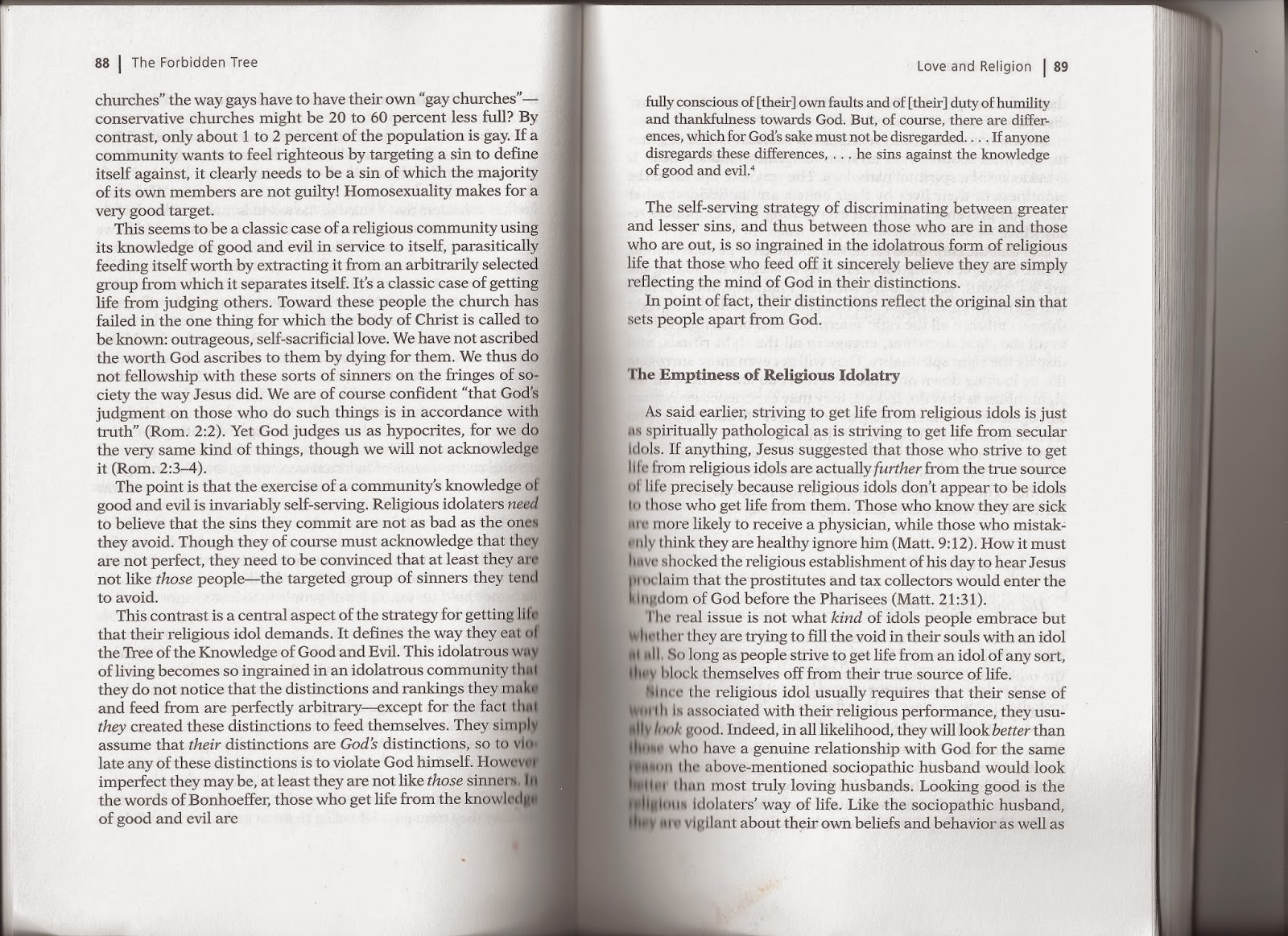
This entire section is powerful and pertinent to some conversations among evangelicals.  I will start by typing out the first few paragraphs before uploading scanned images of the next few pages. 

“Religious idolaters, of course, don’t recognize their idols as such.  On the contrary, part of their religious strategy for getting life is to contrast their ‘true’ beliefs and ethical behaviors with the idols to which secular people cling.  But as a matter of fact, religious idols are just as idolatrous as secular ones.  Indeed, this is the most prevalent and enslaving form of idolatry throughout history….
The standards used to judge others invariably favor the religious people doing the judging.  These standards are, after all, part of their strategy for getting life.  Hence, the sins a particular religious community is good at avoiding tend to be the ones identified as most important to avoid in the mind of that community, while the sins a community is not good at avoiding tend to be minimized or ignored altogether – regardless of what emphasis the Bible puts on these sins.
To give an example, few churches target overeating as sin.  Yet the Bible as a good deal to say about the sin of overeating (gluttony).  In the Jewish culture of Jesus’ day, the inability or unwillingness to control one’s eating was viewed as being on a part with the inability or unwillingness to control one’s sex drive.  Lust and gluttony were two major evidences that a person was undisciplined, governed by ‘shameless passion’ (Sir. 23:6; 4 Macc. 1:3,27).


If this section intrigues you, I strongly recommend that you read the rest of the book.  I’ve pulled another quote from pages 16 and 17 that sums up the goal of the book. 


“Whatever else Christians are known for, they are generally not known for their distinctive love.  Rarely are people drawn to the conclusion that Jesus is Lord simply because of the radical, God-like love the see among Christians and experience from Christians.
Why is this?  What keeps us from living in the place I described above [proving God is real through our love of others]… We position ourselves as judges of others rather than simply as lovers of others.  Our judgments are so instinctive to us that we usually do not notice them.  Even worse, they are so natural to us that when we do notice them, we often assume we are righteous for passing judgment?  Because of this, it is easy to overlook the fact that our judgments are blocking our love, keeping us asleep, preventing us from living in the truth God created us to live in.

We have failed to understand and internalize the biblical teaching that our fundamental sin is not our evil – as though the solution for sin was to become good – but our getting life from what we believe is our knowledge of good and evil.  Our fundamental sin is that we place ourselves in the position of God and divide the world between what we judge is to be good and what we judge to be evil.  And this judgment is the primary thing that keeps us from doing the central thing God created and saved us to do, namely, love like he loves.
Because we do not usually understand and internalize the nature of our foundational sin, we usually think our job as Christians is to embrace a moral system, live by it, and thus to be good people in contrast to all those who are evil.  In fact, I shall argue, God’s goal for us is much more profound and much more beautiful than merely being good; it is to do the will of God by being loving, just as God is loving.  More specifically, I shall show that God’s goal for us is to discover a relationship with him and thereby a relationship with ourselves and others that returns us to a state where we don’t live by our knowledge of good and evil.  Indeed, the goal is nothing less than for us to participate in the very love that the Father, Son, and Holy Spirit share throughout eternity.”


Pg. 89 into 90
[The Pharisees] are vigilant about their own beliefs ad behavior as well as those of other people.  The Pharisees looked better than Jesus’ disciples and the Pharisees knew it.
In fact, however, this hyper vigilance is evidence not of genuine spiritual health but of an inner emptiness and sickness.  It is evidence of a spiritual pathology.  The very attempt to fill the emptiness of their lives by their beliefs and behaviors rather than God prevents them from ever getting their emptiness really filled.
Not that the emptiness cannot be placated for periods of time; it can.  If people’s idolatrous religious strategies for getting life are successful, as they were with the Pharisees, these people will derive some surrogate life by believing they do all the right things, embrace all the right interpretations of Scripture, hold to all the right doctrines, engage in all the right rituals, and display the right spirituality.  They will get even more surrogate life by looking down on those who don’t do and believe all the right things as they do.  Indeed, they may experience even more surrogate life by entertaining a “holy anger” toward those who do not conform to their way of thinking and behaving (a fact that perhaps explains the remarkable divisiveness within Christianity).  But the positive feelings offered by religious idols are fleeting.  The emptiness returns, driving religious idolaters to further futile attempts to get life by their religion.


Pg. 192
For as a matter of fact, none of us have “arrived.”  It’s just that, for self-serving reasons, we’ve decided to categorize some sins – our sins – as acceptable and other sins – their sins – as condemnable.

If we view ourselves and everyone else through the lens of the cross rather than our knowledge of good and evil, we will see that our self-serving categorizations of sin are as unnecessary as they are illegitimate.  In Christ, we all stand condemned and forgive and righteous.  Hence, the prostitute, the greedy, the murderer, the obese, the homosexual, the rude, the unbathed, the drunk, the poor – even the Pharisee if he is willing – are to be welcomed back to the garden with enthusiastic celebration.

Pg. 197
If, for example, a church treats gays with the same compassion religious judges treat their own overweight people, its leaders will likely be condemned as “compromising the Word of God” by these judges.  Such a church is sinning against the (self-serving) knowledge of good and evil from which the religious judges feed.  Consequently, the judges will likely feel as though their god has been assaulted, and, as a matter of fact, it has!  As idolatrous people often do when their gods are threatened, they may rate.  They did so with Jesus and there’s every reason to believe they will do so with communities that look like Jesus.